
Welcome to the Murder of Bill Malloy Expansion Pack DLC.

Dark Shadows has reached the last act of its longest-running storyline to date. The murderer of Bill Malloy has been discovered, but not captured, and while the residents of Collinsport may believe the nightmare is over, Collinwood has a reputation as a house of horrors for a reason.
In my patented three act system for the structure of this storyline, I separated the saga of Bill Malloy’s murder into eras focused on deductive procedure, striking phenomena, and the threat of peril.
We’re in full on peril mode. The mystery aspect of the story has been put away, but Matthew Morgan isn’t in for a clean cut trial and conviction. That’s procedural nonsense. Instead, he’s fled into the night, tricked the characters (er…somehow) into thinking he’s left town and, in reality, has sought shelter right in the Collins family’s backyard, in the ruinous Old House.
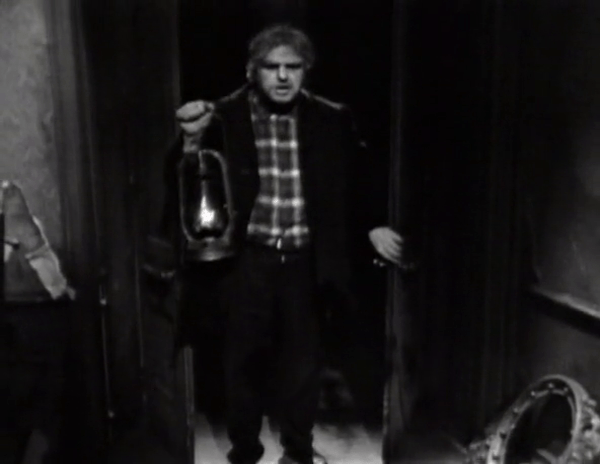
Vicky’s voiceover gets unusually textual, explaining to the viewer that Matthew believes he’ll be safe here because the police have already searched it. I’m still not sure if this is the best location, given it’s still in Collinsport and, in fact, on Collins family property, but we established a while back that he ‘don’t think good’, which makes him perfectly suited for this environment.
And, anyway, Matthew knows a few tricks. Observe how he crosses to some old shelving unit in the main room of the Old House to reveal a secret chamber, the first of many such nooks and crannies this house will reveal to us over the course of the series.
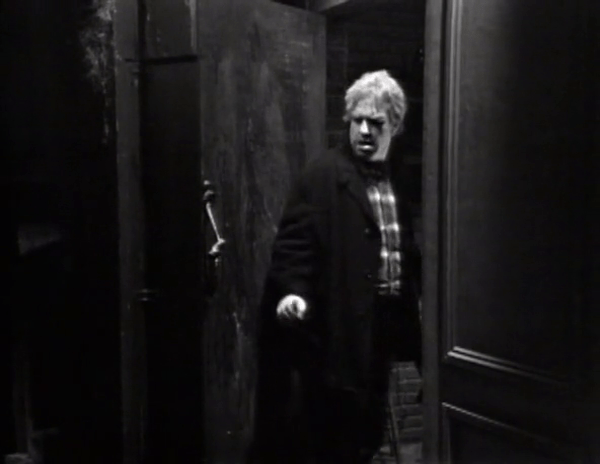
Why is there a hidden prison-cell-like room in the original Collinwood? Who the hell knows? But it sure raises a lot of morbid questions, which is always fun.

He really has thoroughly cooked his goose for no reason. Even if you imagine he had valid reasons for the first two attempts on Vicky’s life, there was absolutely no reason in the world for him to try pushing that ‘stone urn’ onto Vicky. None at all. Roger was already arrested, and they had to handwave that he somehow had gone an entire day without hearing that news.
But that doesn’t matter because we’re here now, and it’s in this last act that Ron Sproat will finally get a chance to make a major mark on the show for the first time.
Except Sproat didn’t right this one.

And, for all intents and purposes, it isn’t a terrible one, which is good news for all of us. Instead, this script is all about place-setting for a world without Swann in it. And, as we’ve seen, Swann has no problems raising questions he will never be expected to answer.
So, it’s a new day in Collinsport, and the gods have finally deigned to show us what the Devlin is doing.
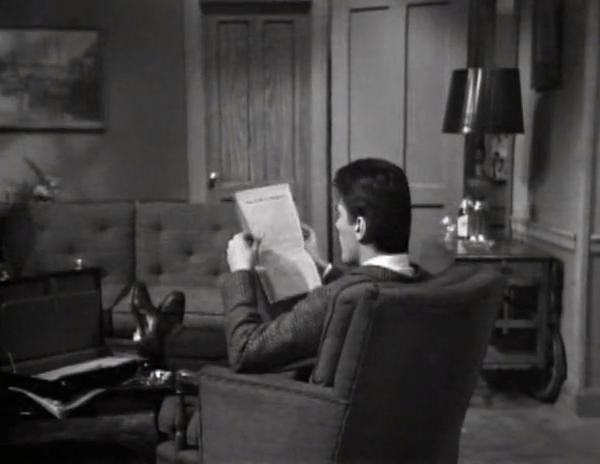
Burke Devlin has been weirdly left out of the story lately. We last saw him congratulating himself after Roger fell for his “crazy plan”, leading to his arrest. That was two nights ago in-universe, and things have changed very dramatically since then. For one, thing, Burke helped the police catch the wrong man, a fact which he will now have to learn from his erstwhile compatriot, Mrs. Johnson.
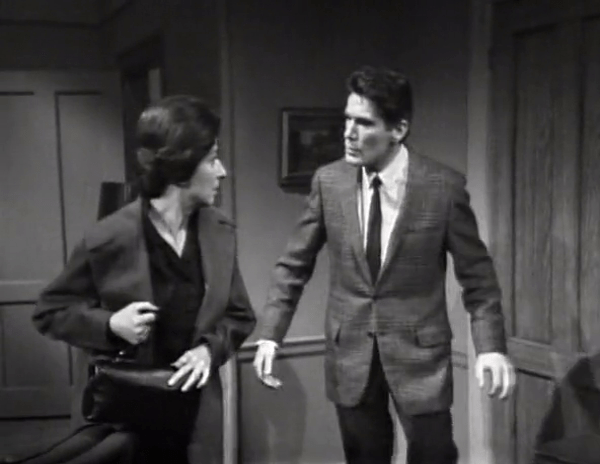
So, here’s a problem: Burke is extremely invested in the identity of Bill Malloy’s killer. Malloy was killed in the course of helping Burke clear his name. Burke was also one of the first characters to realize Malloy had been murdered. His increasingly heated confrontations with Roger have become less about the manslaughter case, and more about Burke’s belief that Roger killed Malloy to keep the truth of aforementioned manslaughter case from coming out.

That is to say, this storyline has essentially been an outgrowth of Burke’s initial campaign of revenge against Roger and his family.
And now it’s been resolved. The mystery has been solved. And Burke wasn’t even there; he has to hear all about it secondhand from the maid, like Upstairs/Downstairs.
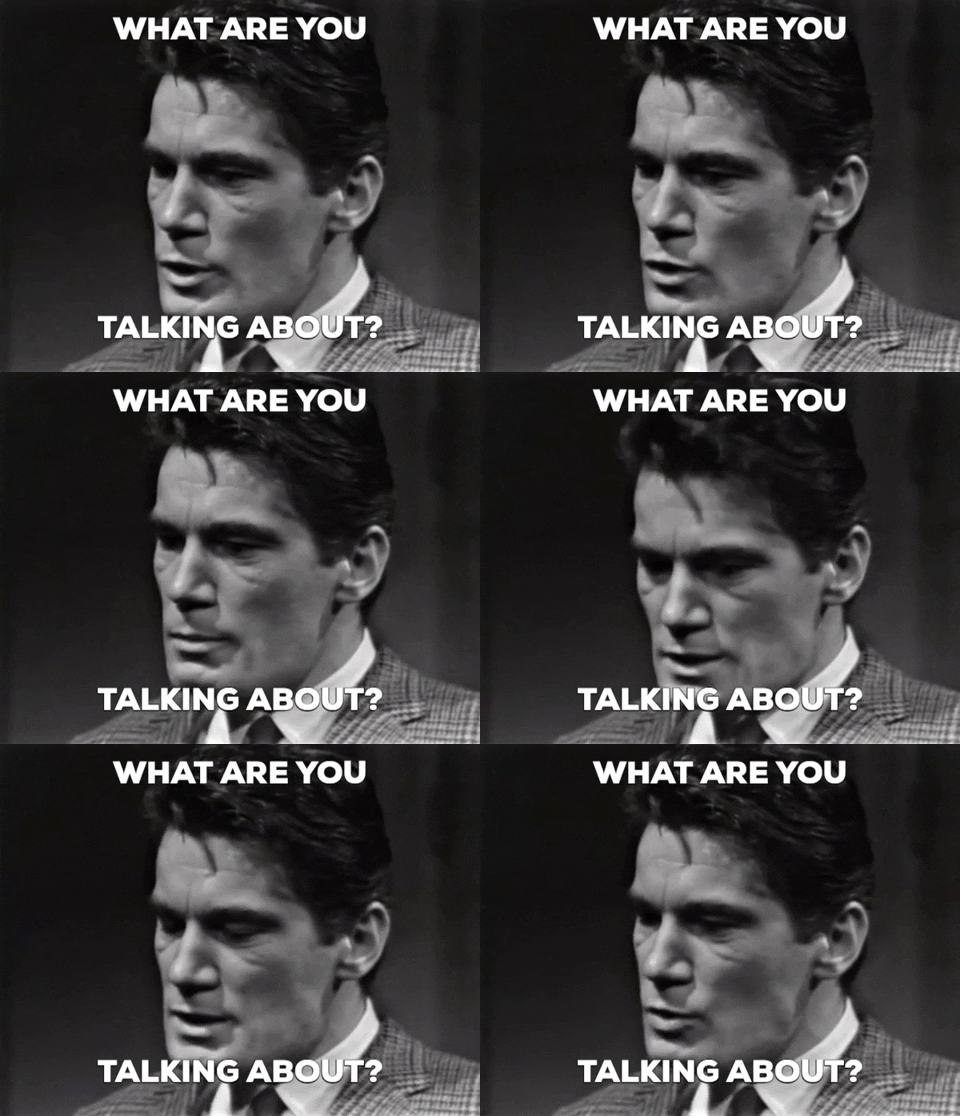
Burke could very easily have been part of the drama occurring between Collinwood and the caretaker’s cottage over the past three episodes. You know how I know this? Because Frank fucking Garner was part of that drama over the past three episodes. Burke could easily have been in Frank’s place.
But Burke has been well-established. The case has been made (not very well, but there it is) for why he should be the central character’s love interest. Frank needs a case of his own, and I guess having him fret and nag while Vicky was missing was as good a case as they could come up with.
So, Mrs. Johnson explains the whole business to Burke and they both have to admit they were wrong this whole time.
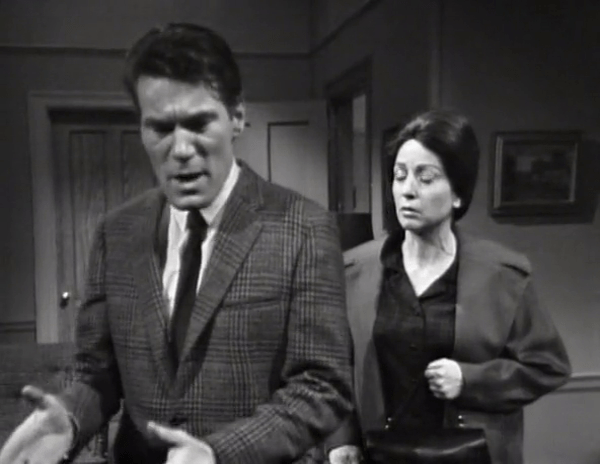
A less-examined side effect of the identity of the murderer changing from Roger to Matthew midway through the story is that now Burke looks pretty stupid. Which is a unique position because up to know he’s always been vindicated. It’s patently obvious Roger was guilty for the manslaughter charge, we knew from the beginning he was being framed for the suppository business, and we knew he was justified to attempt his own independent investigation into Malloy’s murder, even if he never actually learned anything during it.
Burke is the hero. Or, rather, the antihero; the first of many who will grace our screens over the next five years, the most famous of which being the brooding vampire we’ll be introduced to a little under 100 episodes from now. Burke is supposed to be proactive and do things. We expect things from him, even if they aren’t always strictly good things.
And now he looks like a horse’s ass.
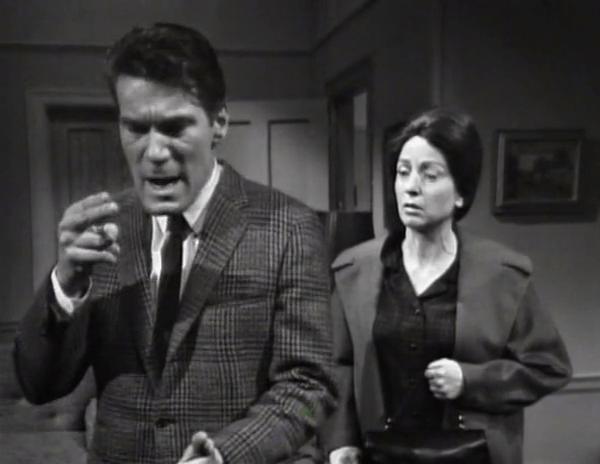
I wasn’t kidding when I said this episode serves mostly as Francis Swann listing all the open-ended plot threads he can think of on the way out the door. That means reminding us that Burke is here for other reasons than to pursue a man for a murder he ultimately did not commit.
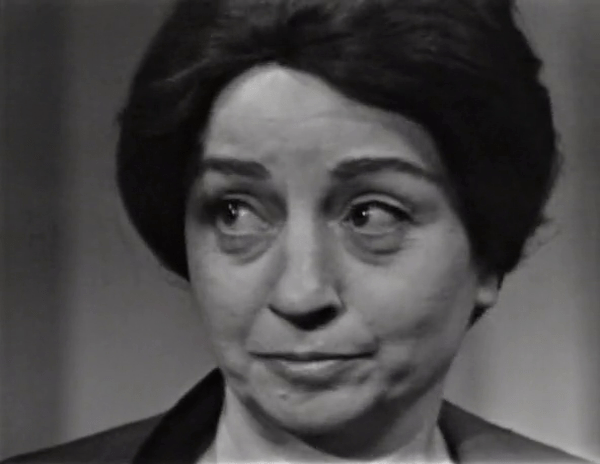
I love her so much. The little side-eye she gives him like, ‘Well, if you want to believe you’re innocent, that’s fine. Won’t change my priors.’
The thing is, Roger was supposed to be the murderer to add some extra villainy and, ultimately catharsis, when Burke finally got him to admit the truth. But now Roger isn’t the murderer and we’re back to Burke pursuing Roger for the original, less dramatic, reason: a crime that happened 10 years ago, involving the death of a character nobody cares about.
As if to hammer in how unmoored his character has suddenly become, Mitch Ryan forgets his line.
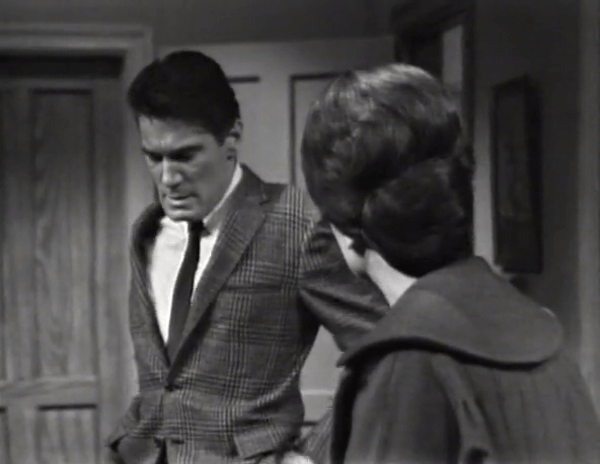

Then he cranes his neck, as if in the desperate hope he can spot his line on the teleprompter. It as at this point that Clarice Blackburn, consummate professional that she is, feeds him his line.
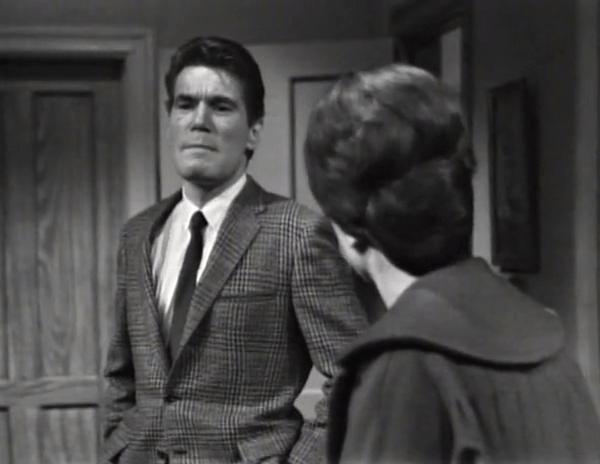
And then it clicks.

I love that. It’s pure middle school play. There are a few such moments like this in the series run, but the more common variant is the actor just fucks up the line and everybody goes on with their lives.
The conversation pivots back to figuring out what the “status quo” is now that the entire narrative has been turned on its head in a one-week span. Burke says he knows Mrs. Johnson only took the job at Collinwood as an excuse to find evidence that Roger killed Malloy, but he wonders if she could stay on and continue spying on the family.
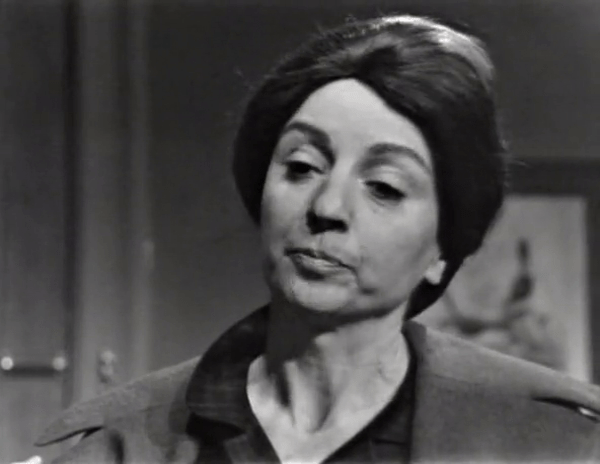
Mrs. Johnson maintains that, even if Malloy wasn’t killed by a member of the Collins family, his death wouldn’t have happened if it wasn’t for his devotion to them, which makes them responsible anyway.

And that’s a fair thing to believe. It’s kind of a stretch, but it doesn’t have to be 100% rational because, for one thing, Mrs. Johnson was in love with Malloy and she seems to always have resented the Collinses for dominating his life. And, for another, we love Mrs. Johnson. She’s a great time. We want to see more of her, even if she no longer has a concrete reason for being at Collinwood.
Anyway, I imagine the Collinses will need the extra help now that Matthew’s gone. And it’s not like this woman has any other means of income. Why would she quit?

I mean, I guess. Possibly. Doesn’t seem like the kind of thing that’d come up in conversation around the house, but Roger’s surprised us before.
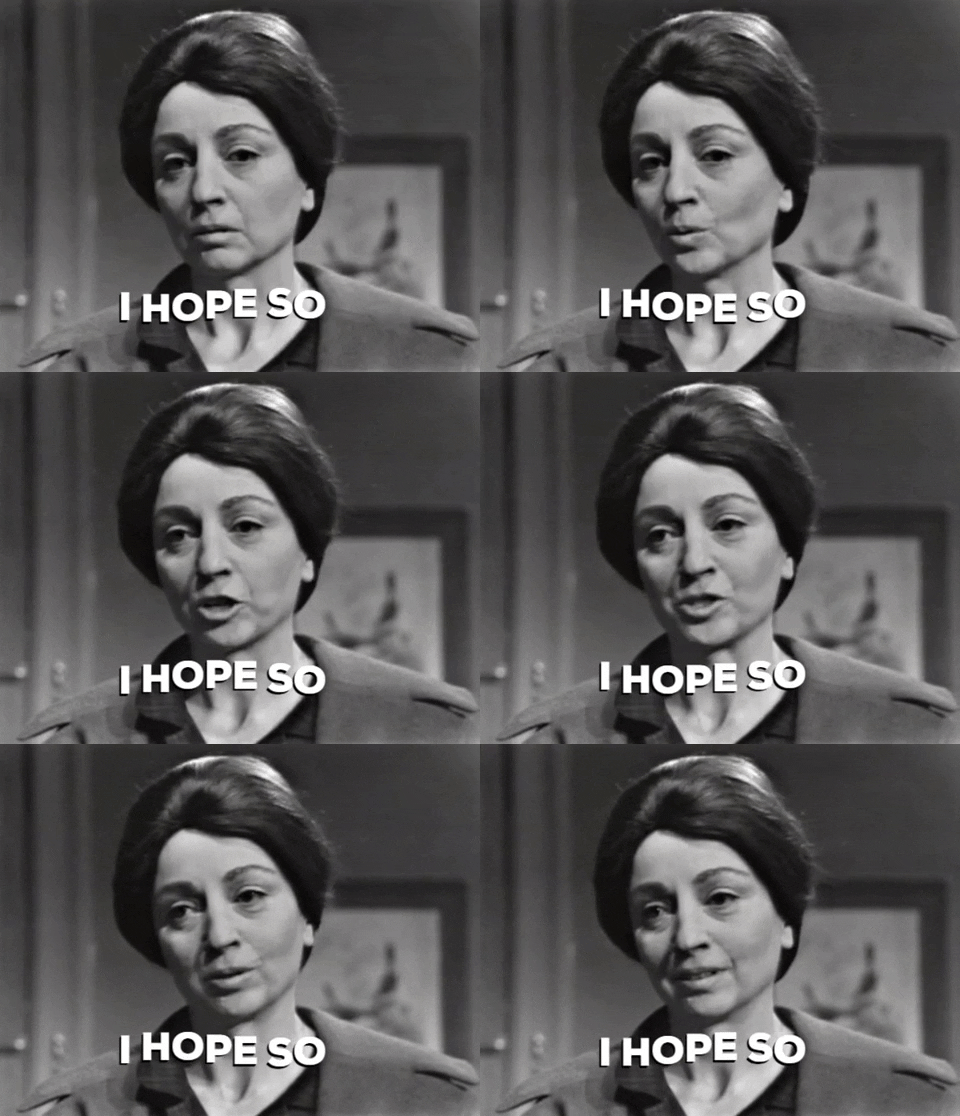
Mrs. Johnson shuffles off to resume her duties at the great house. Act II brings another of Burke’s repertoire of associates in for a visit.

Burke and David scenes are few and far between, so this already becomes one of the superior Swann episodes. He may not be going out with a bang like Art Wallace, but at least he’s making something watchable.

Swann even remembered what a Burke Devlin Special was. He’s pulling out all the stops for us.
So, it turns out David is here because he is also has complaints about recent storytelling developments.
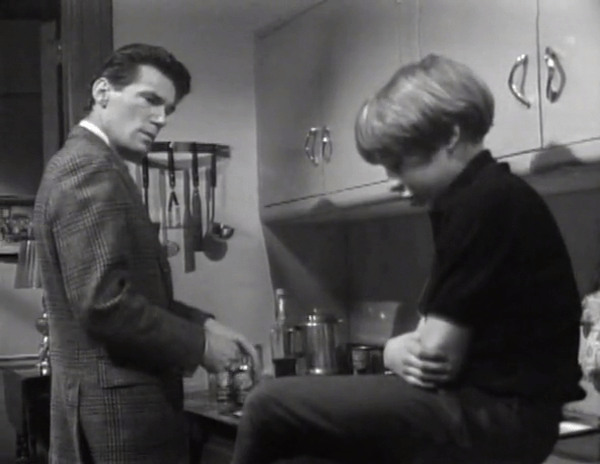
So, yeah, this also effects David, who was the first person to suggest Roger had killed Malloy, back before anybody even knew Malloy was dead. You have to feel bad. He’s not wrong out of his fault. He’s wrong because his father was too fun to get rid of.
In any case, this allows us to get some introspection on the Burke/David relationship. Burke has no warmth reserved for Roger, of course, but he’s fond of David and seems genuinely sad that things are so miserable between him and his father that he’s disappointed Roger won’t be sent up for murder.
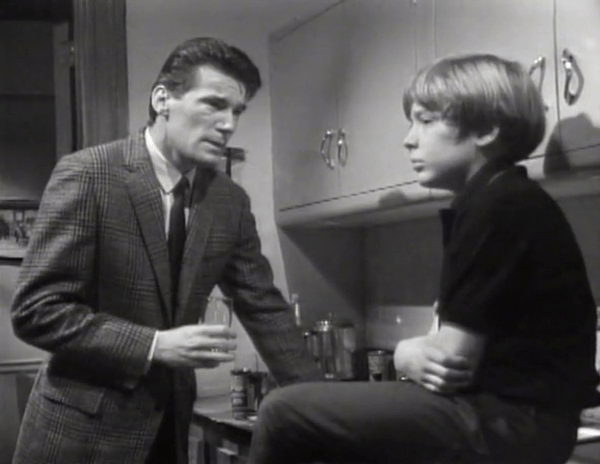
Also, kudos to Mitch Ryan, who works so well with David Henesy. There’s a softness in his performance here that you never see him affect with anybody else. It’s really quite nice.
And David answers him.
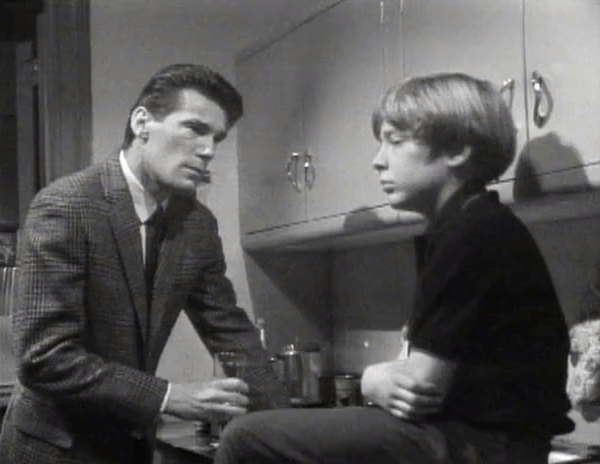
Ah, yes. David’s mother. In case you’d forgotten that he does not, in fact, have two dads. The mysterious Laura Collins is something of a cypher. We know almost nothing about her. She was in the car the night Burke or Roger killed that man 10 years ago. She was Burke’s girlfriend originally, and then got together with Roger right after Burke went to prison. Not longer after, David popped out, which is the source of both men’s uncertainty as to who, exactly, the father is.
More recently, Laura went to a mental hospital two months before the series began (and, in fact, while time has recently accelerated a bit in-universe, we still haven’t accumulated enough on-screen days to make that three months before this episode), at the time Roger and David moved to Collinwood from Augusta.
And that’s it. We’ve been with these people for almost half a year, and that’s all we’ve got on the only known woman in the mythos with the last name “Collins”.
Unless you count Josette, who has gotten significantly more screen time.

Well. That’s dark. Lest we get any delusions Roger has been absolved of all his sins, he still seems guilty of…that. Whatever, exactly, ‘that’ turns out to be.
Which raises a question. Why are we hearing all this now? Might it be the traditional soap opera method of seeding hints for the next story as the old one is winding up? Hm…
Anyway, David still stubbornly believes Roger killed Malloy, and Matthew only took the rap because he’d do anything Elizabeth wanted. Which is quite a complex and morbid theory, but very creative. You have to give him credit.

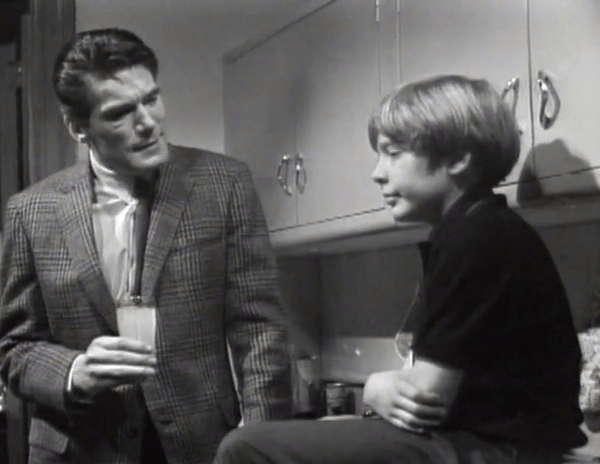
See, this is what retcons do. You get a grown man telling a child about crystal ball mechanics.
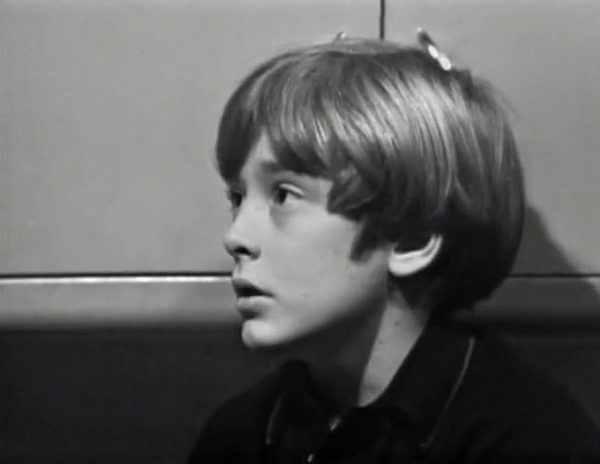
This is a sort of artistic license: a retcon to explain a retcon. David’s ‘vision’ of seeing his father kill Malloy back in September can now retroactively be explained as him seeing Roger come upon Malloy’s body in the moments after he died, which is the “new” version of the truth.
None of this does anything to redeem the crystal ball as a foreshadowing device. Like, I might as well say now that Carolyn isn’t going to marry Burke either. But the prophecy about someone at Collinwood trying to kill Vicky panned out, so there’s that, I guess. Regardless, you can expect the crystal ball to go into cold storage for a while. There’ll be a laundry list of even more inexplicable props before they remember that old thing.
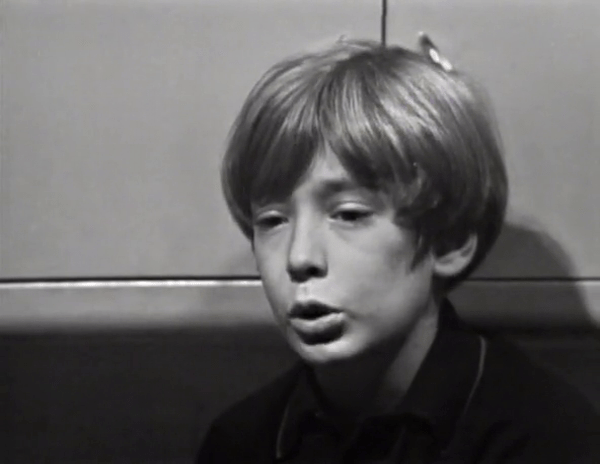

I like this. Burke’s got this little jokey nature about him, and we know he doesn’t believe in ghosts from his interactions with Vicky, but he’s being nice and respectful with David. This scene really is one of the best in Swann’s catalogue from this show. It almost makes me miss him.
Almost.
Things pivot to David…worrying about Miss Winters.
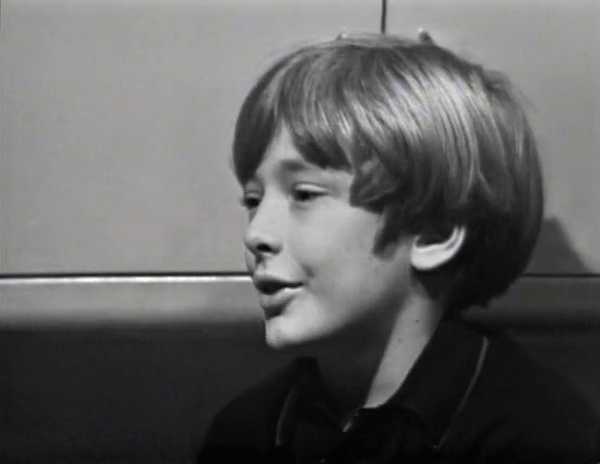
Okay, so we can tack two more things to the ‘open-ended questions’ list: Laura Collins and the ghosts. Two separate issues, but there we are. The more compelling thing at the moment is the ghosts. Dark Shadows is preparing to become a full time supernatural soap. We haven’t had any real ghostly contact in a while, not since Vicky saw Malloy’s ghost in Episode 85. Sure, we saw Josette a second time in Episode 102 but, just like the other times she’s made herself known, it wasn’t much more than spectacle and had nothing to do with the story.
You can’t just drop a line like that and then never pick it up again. And Dark Shadows knows it. Ratings spiked following the first appearance of Josette in Episode 70. The prophecies of Malloy’s ghost already seem to have come true. Somebody in Collinwood did try to kill Vicky, so that wraps up that. But it doesn’t put the question of ghosts, if you will, at rest.
And so, we have the continuing question of whether or not Vicky is fated to plummet to her death off Widows’ Hill, a fate that David seems to want to…protect her from.
This was kind of ambiguous when David first brought this up to Vicky, also in Episode 70, but now in Episode 113, David expresses concern for the governess he once tried to kill.
And…it makes sense. It was seeded in Episode 102, when David worried (to Matthew, natch, which is probably what inspired all those attempts to kill her, but whatever) about his father trying to kill her to keep her from exposing him. David’s hatred for his father has allowed him to begin seeing Victoria as a human being.
And you know what? It makes sense. And it sticks.
Burke points out that the legend mandates the third girl be a member of the Collins family. This is news to me. It was established that the second girl was just a governess and, therefore, not a Collins but…whatever, okay, sure, I guess this sounds more impressive and it gives David a chance to bring up something else for the list:

Ah yes, the mystery of Victoria Winters’s past, that thing that was supposed to be the driving question of the show. Clearly, this should be the top priority on our list of post-murder priorities, right?
Heh, no, it’ll be dropped with a whimper within the month, but at least the outgoing writer recognized it was a question that people might be expecting to have answered at some point.
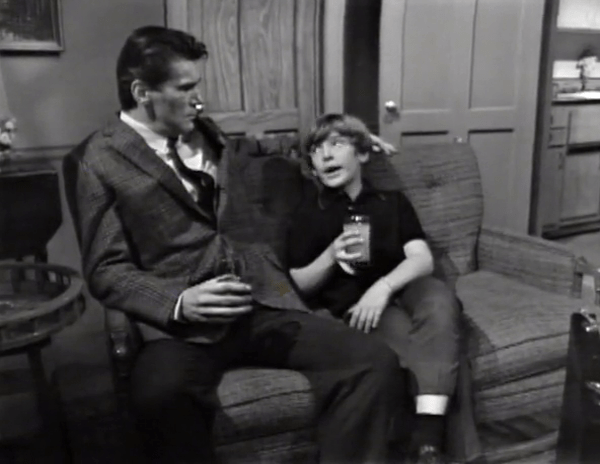
It’s adorable. I could watch a whole 20-minute block that was just these two trawling the Dark Shadows Wild Mass Guessing page on TV Tropes.
David also brings up another contemplation he has.

It’s so great. He’s been onto this Burke/Mrs. Johnson thing from jump. There was never a second when he wasn’t onto it. Meanwhile, nobody else at the house has gotten a shred of a clue, not even Carolyn, who was abjectly manipulated into getting Mrs. J hired by Burke himself.
A flustered Burke is quick to dismiss this theory, but as this murder mystery storyline has told us, Burke is wrong a lot of the time, and David shouldn’t pay any attention to this.
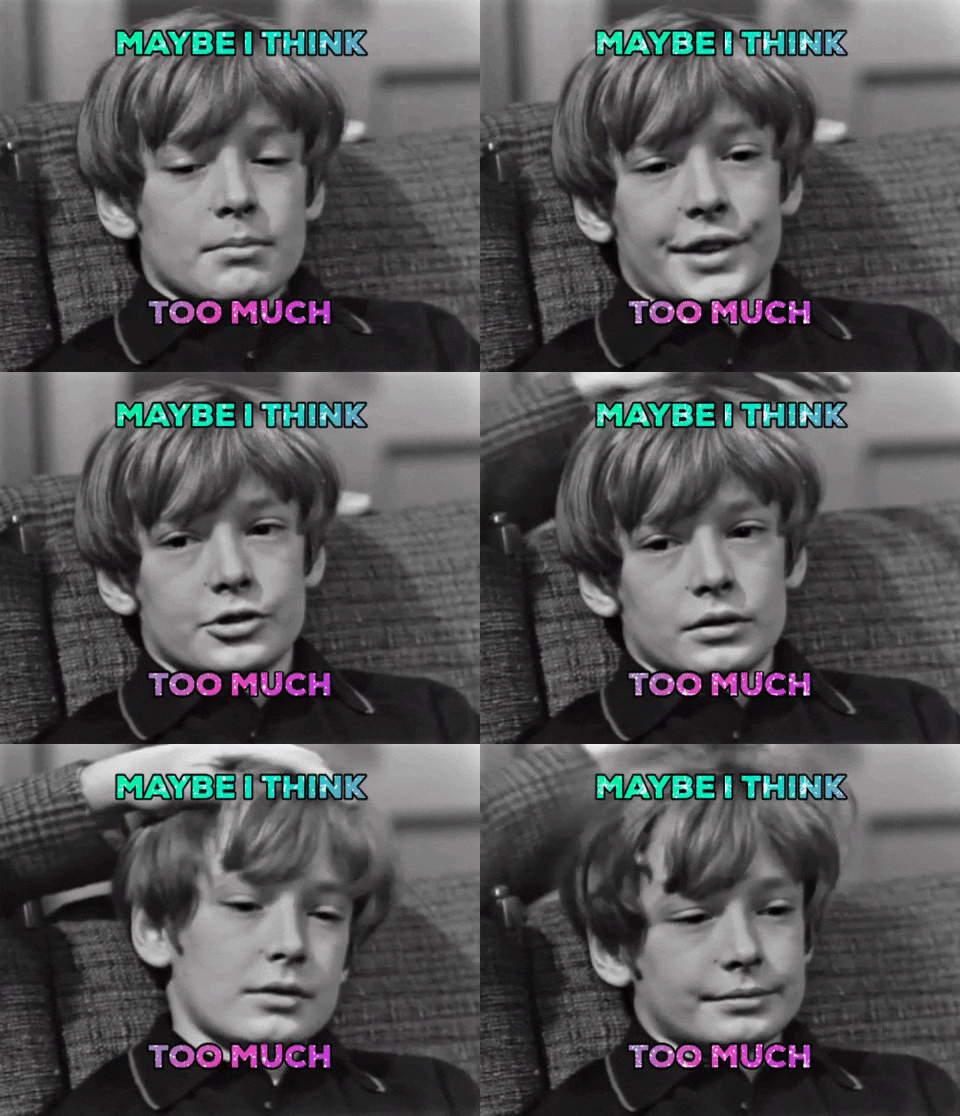
Someone has to around here.
And now back to Collinwood for Mrs. Johnson and her housedress.

David returns from his excursions and begins bantering with the maid, which is always fun TV.
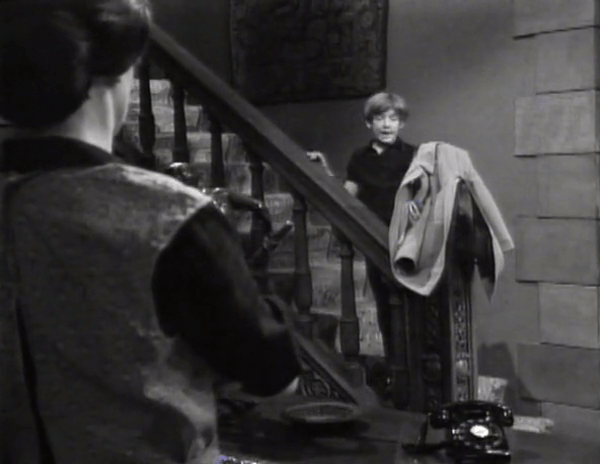
The damnedest thing is, he proceeds to hang up his coat. It’s almost like he’s learning to pick his battles. Dark Shadows is a coming-of-age story on top of everything else.
This quickly progresses into an excuse for David to continue implying that he knows what’s up. No reference is made to their prior interactions on Mrs. Johnson’s first day in Episode 98, so it’s unclear if Swann knew this had already been done, but I have to imagine he did and just decided to have Mrs. Johnson act like this was the first time David has suggested she’s in league with Burke to destroy his father.

I’m not sure how to adequately convey the reasons this dynamic works. He’s a snot-nosed child literally talking down to a grown domestic. It’s one of those time-tested archetypical relationships, like Richie Rich and The Suite Life of Zack and Cody.
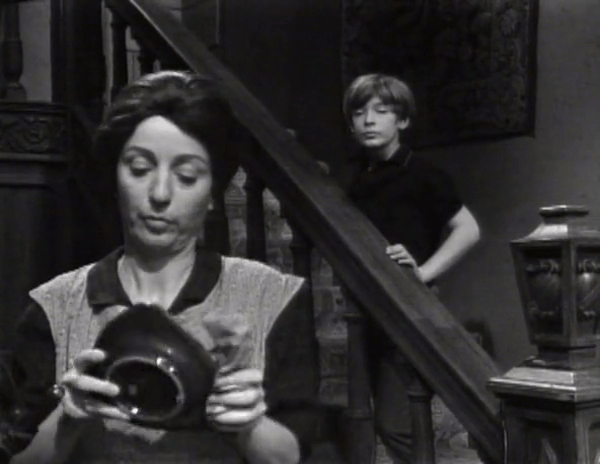
David promptly announces he’s going to the Old House to commune with the spirits, and Mrs. Johnson’s primary objection is that he may miss dinner. I think she’s going to make an excellent addition to the household.
A great detail here is Mrs. Johnson not scoffing at the idea of David’s ghost friends, though he thoroughly expects her to. She surprises him.
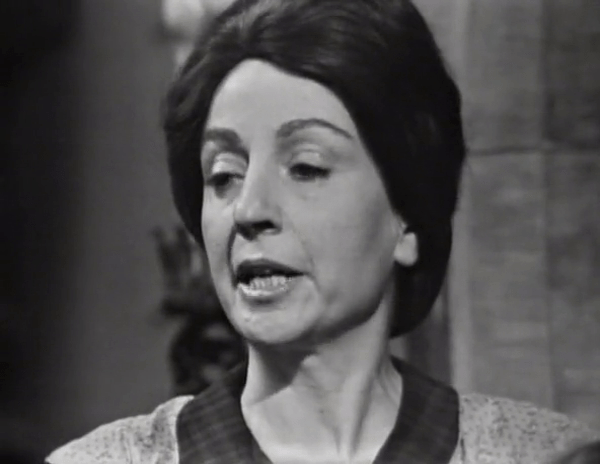
She only points out that any facts the ghosts might tell David wouldn’t hold up in court. But she doesn’t disbelieve him. She’s the first adult he’s told about the ghosts who doesn’t doubt him for a second. I love her so much.

And Mrs. Johnson doesn’t seem to see any errors here. She just reminds him to come back in time for dinner. Which is probably irresponsible, but it’s not like the other adults in this house have been taking particularly good care of this child in the first place.
Here, have some location footage of David Henesy frolicking in the woods.
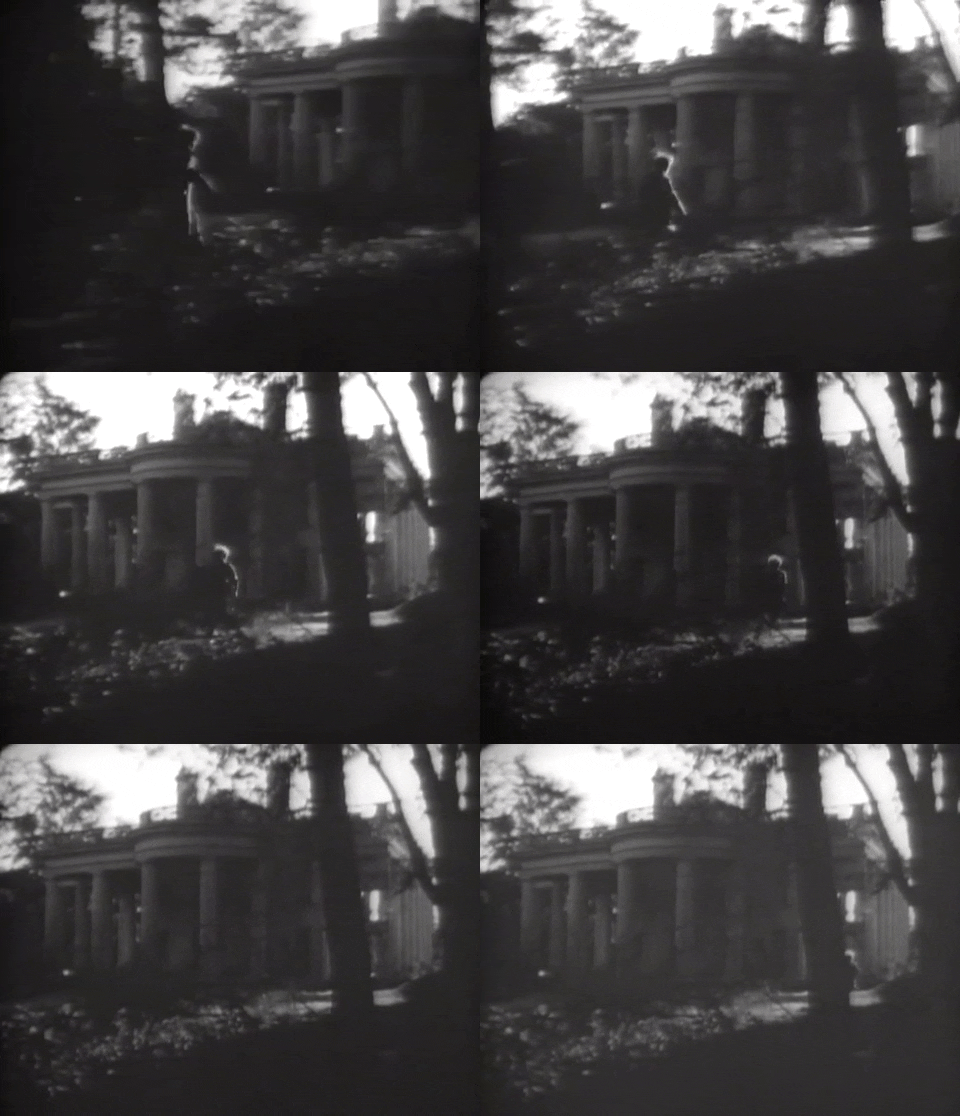
So, David arrives at the Old House and begins yelling at Josette’s portrait.

It’s like he’s praying to her, as if he revers his ancestor as some kind of god. It’s not quite as risqué as Matthew talking about snapping a girl’s neck, but it’s still somewhat transgressive. Ancestor worship on daytime television! Since frigging when?
In fact, the communion between people and ghosts in this period of the show is similar to the discourse between the faithful and God. Ghosts appear only when they like, they never answer your prayers in clear, specific ways (“riddles to figure out” as Burke would say), and sometimes their answers are downright inconvenient. For example…
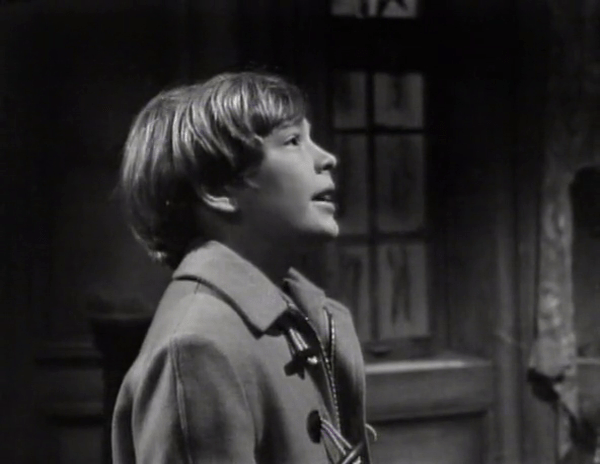
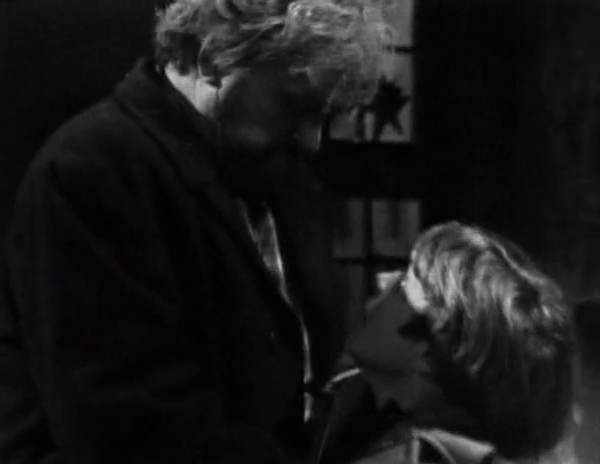
Pretty boneheaded move by Matthew. He could’ve laid low the moment he heard David’s voice, even if he wasn’t currently in his airless slave hole or whatever that secret room is for.
Then again, it was also stupid for him to hide out in the Old House after all. Even if his goal was to convince the police he’d gone miles away from town, he knows David comes to the Old House all the time. The last time he spoke to him was in this house a few nights ago.
So, David takes this whole thing like a champ, all things considered. He’s very calm and measured, probably because he’s convinced himself Matthew isn’t really a murderer. He even tells Matthew this, and Matthew, bless him, seems genuinely confused he still thinks his father did it.
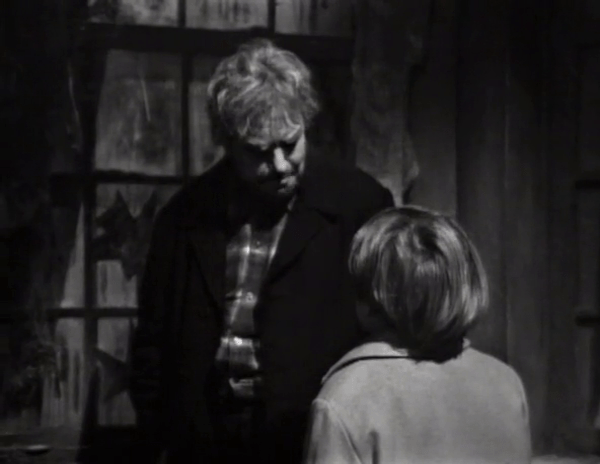
Listen, guy, don’t look a gift horse in the mouth.
I should also point out that we are now putting children, as well as women, in peril. Even if David doesn’t realize it, he is in a dangerous situation. This man is an insane murderer.
As a culture, we’re considerably more ambivalent about the ‘child in peril’ plot device. In fact, we’re so cool with it, that forty years of Saturday morning cartoons built a lexicon of children and teenagers being abducted, hogtied, brainwashed, and menaced by everything from aliens to cops to men dressed as pirates. The difference between the child in peril and the woman in peril is that the woman is usually saved by somebody else, most often her male love interest. But the child in peril is expected to save themselves, usually using their wits.
And David Collins is a very witty child. Even if he doesn’t understand exactly what Matthew is, he works on him in this scene, proposing an alliance to find “evidence” proving Roger is the murderer.

He said the title!

This is incredible. This man could snap David in half with his hands, and he’s here considering his insane nonsense proposal like it’s a suitable alternative to fleeing to Canada.
Matthew tells David not to tell anybody at Collinwood he saw him, clearly intending to use this as a window to escape, but David says he can’t leave, because Matthew is the key to proving his father is the murderer.
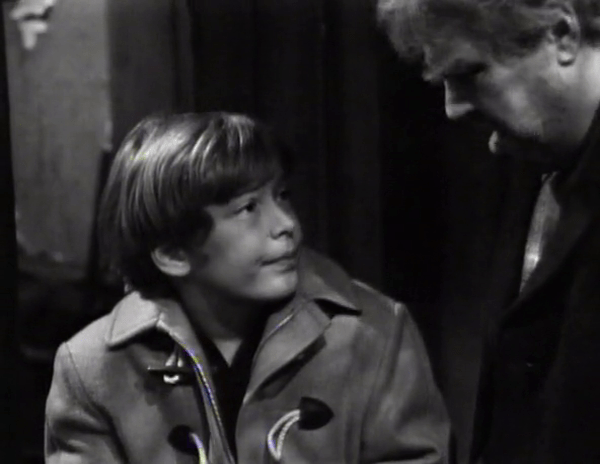
It’s remarkable. He’s laying the case out so perfectly that Matthew can’t say shit otherwise.
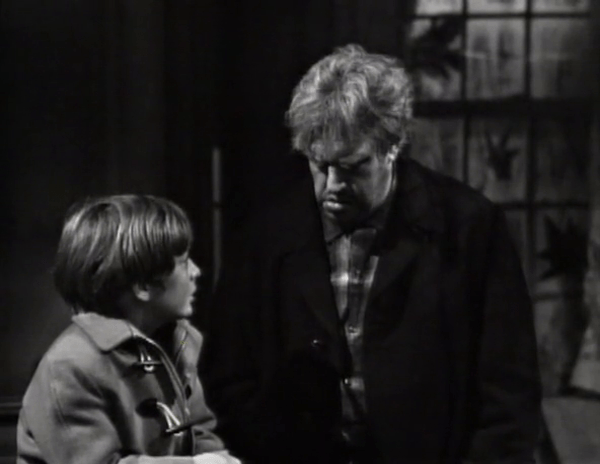
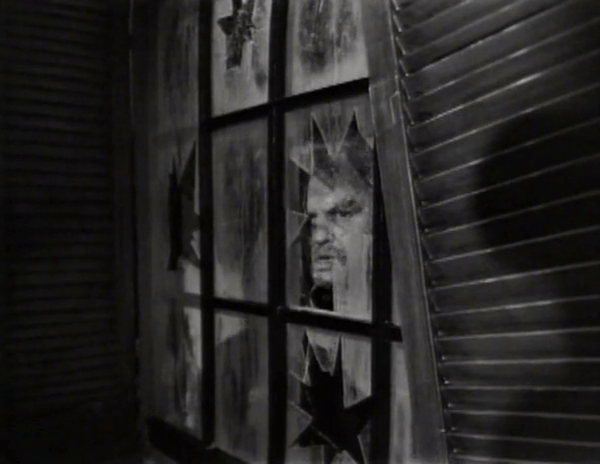
But, yes, Matthew considers David’s proposal and is left with no choice but to accept.

Josette works in mysterious ways.
Behind the Scenes Shenanigans
Francis Swann was not a good writer. At least not on Dark Shadows. There, I said it. We’ll never have to deal with him again, so I can now talk about him without fear or ire.
After Dark Shadows, the prolific genre screenwriter and one-time Broadway hit penner declined prodigiously. His only major credit after 1966 was as screenwriter and story developer for 1969’s The Candy Man. Not the one you’re thinking of. This Candy Man was an action thriller well in Swann’s earlier niche from the 1950s and early ‘60s. It starred George Sanders (most known to audiences today for 1950’s All About Eve) in one of his final roles.
Swann appears to have retired from writing after The Candy Man. He passed away in 1983 at the age of 70.
This Day in History- Wednesday, November 30, 1966
Three ceasefires centered around Christmas, New Year’s, and Tết in the Vietnam War. These ceasefires would be observed without commotion, though the precedent would not last the length of the war.
The unusual origin of gloopy sport’s drink Gatorade becomes known when a Miami Herald sports columnist sees members of the University of Florida football team (the Gators, natch) drinking weird shit out of mil cartoons. Gatorade had been developed by a medical professor named Robert Cade to keep athletes from sweating. The beverage would see mass production in the new year.
The island of Barbados gains independence after 341 years as a British colony.
For your daily dose of obligatory period bigotry, Dr. Ralph Greenson, a psychiatry professor at UCLA, expresses distress at the growing number of people seeking gender-reassignment surgery, saying as well that American men have become “indifferent to sex” and the growing Women’s Lib movement is a major turn off for men in general. He worries that humanity will eventually die out. I will gladly tell you from my vantage point here in 2021 that humanity is still here and, as a man, I’m not ‘indifferent’ to sex. It’s just that sex seems indifferent to me.
 Kooks of Collinwood
2 thoughts on “Boy Genius”