
Those silly women, always getting in peril and whatnot.

Italian director Dario Argento, innovator of the shlocky blood and gore gialli pictures of the 1970s, has famously said that he victimizes his female characters because nobody wants to see an ugly woman be tormented.
On a softer note, American avant garde director David Lynch has expressed a fondness for stories about “women in trouble”, with a running theme in his work being harried young blondes beset upon by dark, sometimes supernatural forces, that manifest as allegories for the cruel evils of an impure world.
People like watching women in trouble. There’s a reason the stock horror protagonist is a woman. It isn’t a very…progressive reason, but at the same time, the elevation of the woman as protagonist was, for a very long time, something unique to horror and romance. Men cornered the market everywhere else.
While the centralization of the woman in a romance story makes sense…women have long been the primary consumers of that genre…the same rationale doesn’t apply to horror. While female horror fans have always existed, it would be revisionist, to say the least, to suggest any of the great scribes and directors of the genre were catering to a female audience. If they thought of women at all it was as victims.
Because, well…gender roles. You see, media reflects culture, and horror is an evolution of folklore, which is itself a cousin of myth, which is itself two steps from religion, which serves as a codex of rules and regulations for societies.
The role of the woman in these codexes, in these faith systems, and descendent legends, myths, bedtime stories and eventually works of media, was someone who needed to be protected. This probably isn’t news to you, it doesn’t take a Gender Studies degree to understand how traditional gender roles work.
But it’s how we get the monster killing Frankenstein’s fiancé, and Dracula preying on all those ladies under the nose of the oblivious narrator. It’s how the Cat got the Canary, why the Phantom chased Christine, and why untold hundreds of kinky-haired buxom beauties ended up in the crosshairs of so many Jasons, Freddies, Micheals, and Leprechauns.
It’s why people keep trying to kill Victoria Winters. Well, I shouldn’t say trying. We’re over 100 episodes in, and somehow her near miss with a speeding car is the first time she’s been directly placed in imminent danger.
Because our historical lexicon places woman in the role of “creature who is victimized and therefore needs rescuing”, we get characters like Vicky: plucky, virginal (they must be virginal), bright-eyed girls (Roger once compared her to Pollyanna) who don’t mean any harm and have no idea what they’re getting themselves into. This kind of character would never have been center stage in any other genre not made for little girls. So, on the one hand, that’s kind of cool, that we’re given a character not designed as a femme fatale or a vixen in a genre oriented to adults…
On the other, the poison pill is that this character will never be able to rescue herself. That’s where Van Helsing, and Dr. Frankenstein, and Raoul all come from. The exception to this in horror is the slasher subgenre, in which the designated Final Girl is usually the one who defeats (or seemingly defeats) the slasher killer in the climax. But the slasher is a more modern form of the genre, and it was barely nascent in 1966.
And so, here we are, in Dark Shadows Episode 105, watching as two men argue about the best way to save the woman in peril.
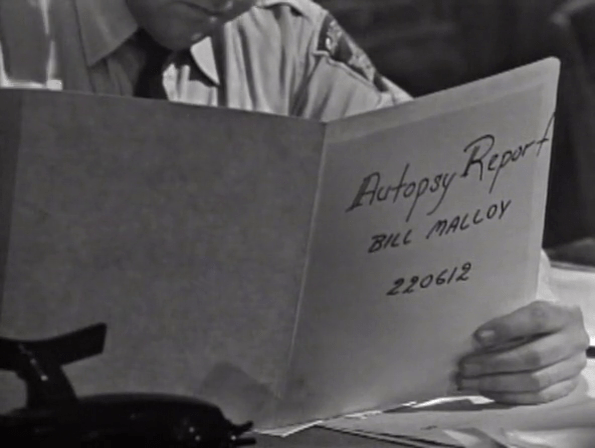
I said this the last time he appeared, but Sheriff Patterson has been remarkably uninvolved in this story in recent weeks, despite being an almost regular presence early on. He stuck around long enough to question the relevant suspects and dispense information as to the autopsy report and coroner’s verdict before all but dropping off the map, appearing only twice since the reintroduction of the silver filigreed fountain pen: the first time, to scoff at Burke’s pen theory, and the second time to rescue Vicky and Roger from a shack at the side of the road in an episode I’m still not entirely convinced really happened.
This is somewhat understandable, as this particular variety of murder mystery doesn’t exist for the police to solve it. We’re more in Murder She Wrote territory, in that the solving of the case involves police, but they are either too incompetent or too uninvolved in the case, necessitating that other, amateur sleuths, take up the mantel.

That seems to have been the role taken up, not just by Victoria Winters, but by Burke Devlin, who swore early into the investigation that he would solve Malloy’s murder, though he’s been less interested in doing any detective work than in simply accusing and assuming Roger Collins is the murderer and working his way back from there. It’s only recently (thanks primarily to the efforts of his lady counterpart, Vicky) that he’s gained any traction in this search, which makes him less a brilliant detective and more a forceful personality who looks like he’d be right at home as a vigilante investigator, if only it wasn’t so much effort.
Burke has raced back from a mysterious engagement in Bangor, where he’s been since last night, executing a plan he gave Vicky no details of. He’s made the Sheriff’s office his first stop so he can demand Patterson reopen the Malloy case.

At which point we learn Patterson never closed the case, despite the coroner’s verdict ruling Malloy’s was an accidental death. This is a cool revelation for the character, as it reveals he’s really quite a wily specimen (true to his delightful, snarking nature), and nowhere near as primed to be cowed into submission as his Consteriff predecessor.

However
It’s also a cop out for writer Francis Swann, as he enters his third-to-last episode, and final Friday episode over all. By revealing that Patterson has been quietly investigating the case the whole time, we’re meant to excuse his relative absence from the narrative in recent weeks. Though we never saw him doing any detective work, we must now suppose that he did.

The whole ‘Collinsport native’ thing is a concept innovated solely by Swann, and used solely by him. It was first introduced last week when Sam told Victoria that the Evanses aren’t natives to Collinsport, unlike the Collins family, defining “native” as any family who’s been in town around 200 years. Here, Patterson uses the same term to place his family and the Devlins in the same category.
I guess it counts as worldbuilding. It’s not particularly impressive worldbuilding, and not the kind that does much to improve one’s understanding of the fictional world, but whatever.
Patterson brings up his, er, nativeness to bring up a point as to why he kept his investigation quiet.
Swann is really churning out every cliché in the book on his way out the door, huh?
Patterson’s rationale is that, if the verdict came in “killed by person or persons unknown”, we’d have had something of a Monsters are Due on Maple Street scenario with everybody in this very small town suspecting everybody else. He wanted to prevent that chaos, and so quietly kept the case open so he could gather more evidence to determine a concrete person of interest.
And I’m sure that makes sense, but I also think the show would’ve benefited from everybody suspecting everybody else, because that’s generally what one does in a murder mystery story. Who Shot J.R.? is the most famous soap opera mystery story primarily because it made pageantry of the characters going all out in suspecting each other. The chaos was the point. Having a single, isolated investigation while every other character tries to distance themselves from the whole thing as much as possible is not very compelling television.

I mean, I guess, but why is Burke even here? Didn’t he receive an urgent call last episode to the point where someone warned him someone was trying to…

Okay, yeah, so Burke knows Vicky’s near miss with the speeding car earlier tonight.
Why, why didn’t the episode begin with a furious Burke charging into the station, demanding Patterson get off his beautiful bodacious ass and get to Collinwood because a girl was almost killed? Why sit on opposite sides of the desk and let Patterson genially explain how he was only pretending to be a useless excuse for a public servant? Surely there was time for him to explain that later, if it really had to be included at all.
It’s a complete and utter failure to capture the tone of the moment. The woman is in peril. Ergo, the man should be on a righteous quest to get her out of peril, fueled by anger and passion. These people can’t even get their outdated gendered formulae straight!

Burke begins very casually explaining the case against Roger, and I really feel like there should be a lot more…er…acting going on here. You know, screaming and yelling. Maybe throw some papers, instead of looking at them like your lines are written on them.

Burke tells Patterson about both mysterious attempts on Vicky’s life: the car and someone trying to get into her room last night. This isn’t really worth breaking down, except for at the end, when Patterson wonders if Vicky could identify the man who tried to get into her room.

This is, again, something that would be easier to accept if this scene hadn’t begun with these two bantering. I want to believe that Burke will put his machismo powers to good use for once and go out, guns blazing, after whoever’s tormenting his lady, but I guess Francis Swann thought it would be sissyish for Burke to display any genuine emotions, positive or negative, for the wellbeing of his primary love interest.
Burke tells Patterson that Vicky saw a tall figure standing in the doorway, which does point to Roger, but is also nothing we ever actually saw. Then again, we also didn’t hear half the things Malloy’s ghost apparently told Vicky in that episode, so…
Also, are we just going to ignore that Roger happened to show up on the scene not ten seconds after she screamed? Are we supposed to pretend it wasn’t that that told most clearly against him?
We return to Collinwood, where Elizabeth is again waiting for Roger.
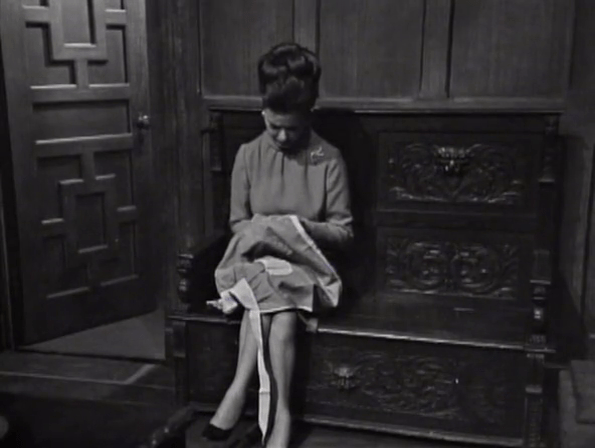
Actually, I do like that Mrs. Stoddard does her own mending. It fits with her as not being some uppity rich lady. Then again, she’s also paying Mrs. Johnson a salary now, so…
Roger returns from his ambiguous trip into town to “search” for Vicky.

No, it isn’t. in fact, Roger made a similar quip to a very similar question the night Malloy died, when he returned to Collinwood in suspiciously high spirits after leaving the meeting that never was.
Roger seems to have abandoned his original motivation of “looking for Vicky”, claiming he went driving along the coast.
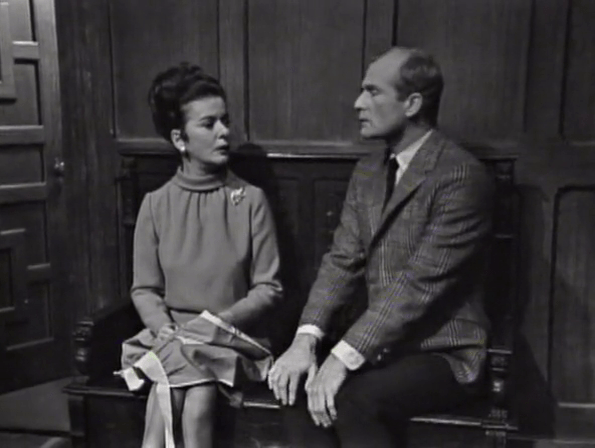
For those of you not watching along: yes, this is all delivered like a schoolteacher scolding a child.
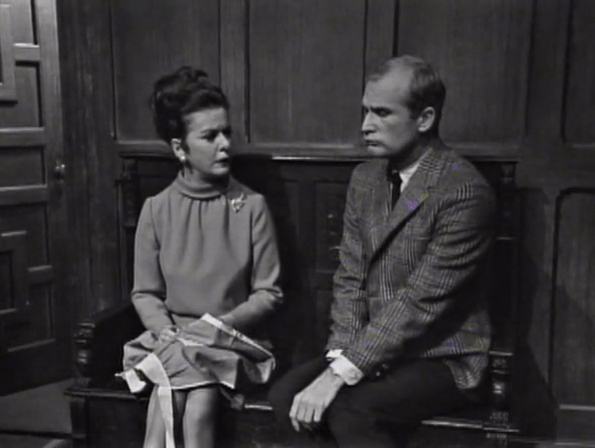
I don’t mean to disparage anybody, but you can always tell when a writer loves the smell of their own farts.
Liz tells her brother about Vicky’s scare on the road tonight and he acts as you would expect.
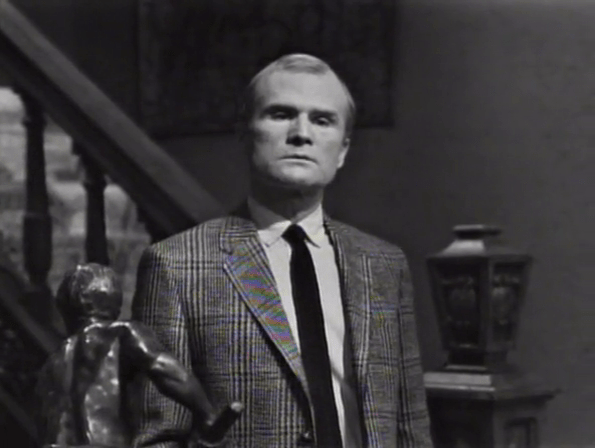
Elizabeth would be totally justified to start hitting him about now. Also, this isn’t the first time Roger’s thrown Sam under the bus. You’d think he’d be warier of the holder of the secret that would immeasurably destroy his life.
Still, it remains that Sam is as much a suspect as Roger in this. It’s the only reason for his out-of-nowhere meeting with Vicky in the Blue Whale last episode, where he deceived her into going to meet with him and desperately attempted to convince her either to tell him what she suspected about Malloy’s death or just drop the whole thing entirely. Just in case you were worried Maggie had been brought into the storyline for reasons having to do with her for a change.
Of course, while Sam and Roger are both suspects in the hit-and-run, Sam can’t possibly be a suspect in breaking into Vicky’s room. Besides the fact that he would’ve had to break into Collinwood too, he also can’t be described as “tall”, thereby not matching the figure Vicky saw in the doorway. So either we accept that these two attempts were made by different people, or that Sam is a particularly poorly conceived red herring and the same person was, in fact, responsible for both attempts.
Back at the Sheriff’s Station, Patterson implies he doesn’t think Roger has the cajones to actually kill anybody. And, you know, it’s not a bad argument, but what’s the alternative at this point.

I mean, I assume that was the intention of whoever tried to break in. I mean, what else would they have intended? Pose as a ghost in an attempt to scare her…
Oh. Oh, yeah, he’s actually tried that before. Maybe that is what was going on.
These two start chatting about the hit and run like it’s a mildly diverting news item. What the fuck is Patterson doing? He even suggests Vicky would be more likely to tell Burke about it than him, which neglects both that Vicky already told Burke, which is the only way he knows, and is also a patent abdication of his job as one who investigates crimes. Then again, his establishing scene had him not press charges against a man who confessed to pushing a dead body back into the ocean to avoid a scandal, so…
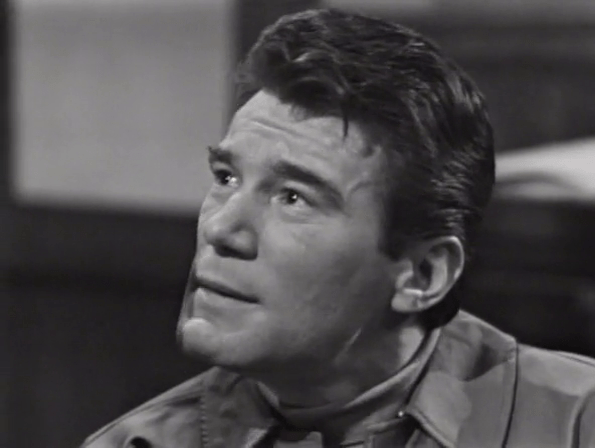
He acted surprised to learn this guy was, in fact, doing the job for which he was elected, but sure, I guess flattery will get you anywhere.
Burke tells Patterson about his “crazy plan” to get evidence, saying they could put it in motion as soon as tonight. Patterson is tickled at the notion and the boys go on a field trip to the great house.
Before they get there, however, we get to watch more nonsense.

Because we have to fill up 21 minutes somehow.
Roger’s various excuses for implicating Sam are so nonsensical I’m embarrassed for a fictional character. He suggests it’s suspicious that Sam gave Vicky the Betty Hanscom painting. That’s it. That’s…that’s what he’s going with. It’s like he realized he shouldn’t be implicating his accomplice in this too late and is now trying to discredit himself.

Girl, I wish, but it’ll be more than a year before this show learns how to mix storylines together.
Liz points out the obvious fact that Sam can’t possibly be suspected as the one who tried to get into Vicky’s room, at which point Roger returns to form, suggesting Vicky probably just imagined that.
Liz brings up the ghost of Bill Malloy, an apparition you will recall she tentatively believes in, to Roger’s bemusement. She even mentions the seaweed they found which, again, they have never told Vicky about, despite the fact this would prove she isn’t going crazy.
Before we can elaborate as to how this midnight visitor may, in fact, have been a ghost, Liz sees the Sheriff’s car pull up and the real fun begins.


Swann was so lucky there was a homosexual playing Roger Collins. Also, why is Roger calling Patterson the Sheriff of Nottingham, a folkloric character famous solely for being repeatedly outsmarted by a band of criminals? Does he think Patterson will read this as a compliment or is this like when he tried to intimidate the Consteriff into kissing his ass?
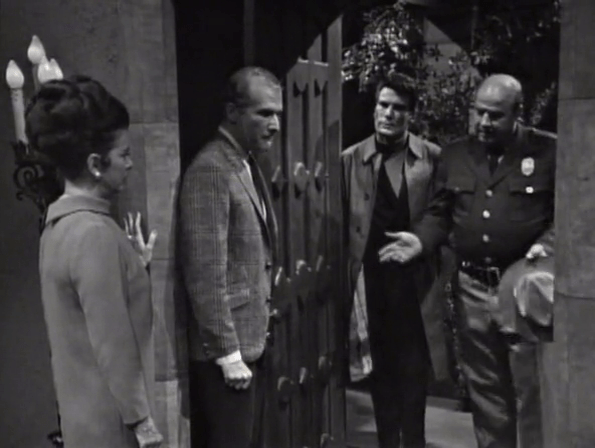
The saving grace is always gonna be Roger vs. Burke. Also, now that Burke’s opened his coat, we can see he’s wearing his turtleneck, which only increases the sexual tension of the forthcoming conflict.
Upon being admitted to the house, Burke demands to see Vicky, which he can’t do, first because she’s been in a lot of episodes recently, and secondly because Elizabeth’s got her knocked out upstairs on a dose of Belliman’s Fantastic Syrup.
This complicates things, somewhat, because Vicky is the only witness to her encounter on the road, which is the ostensible purpose of Patterson’s presence here.
But I’m sure these two knuckleheads will figure something out.
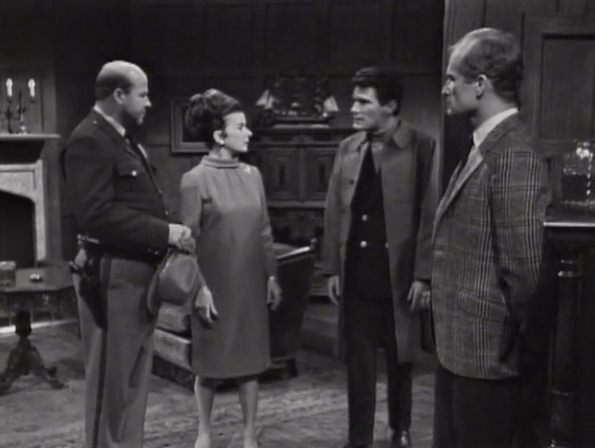
Patterson asks about the break-in from last night, and Roger begins repeating his party line (for a party of one: himself) about her imagining the whole thing, expanding on it in a way that immediately destroys what little credibility the story already has.
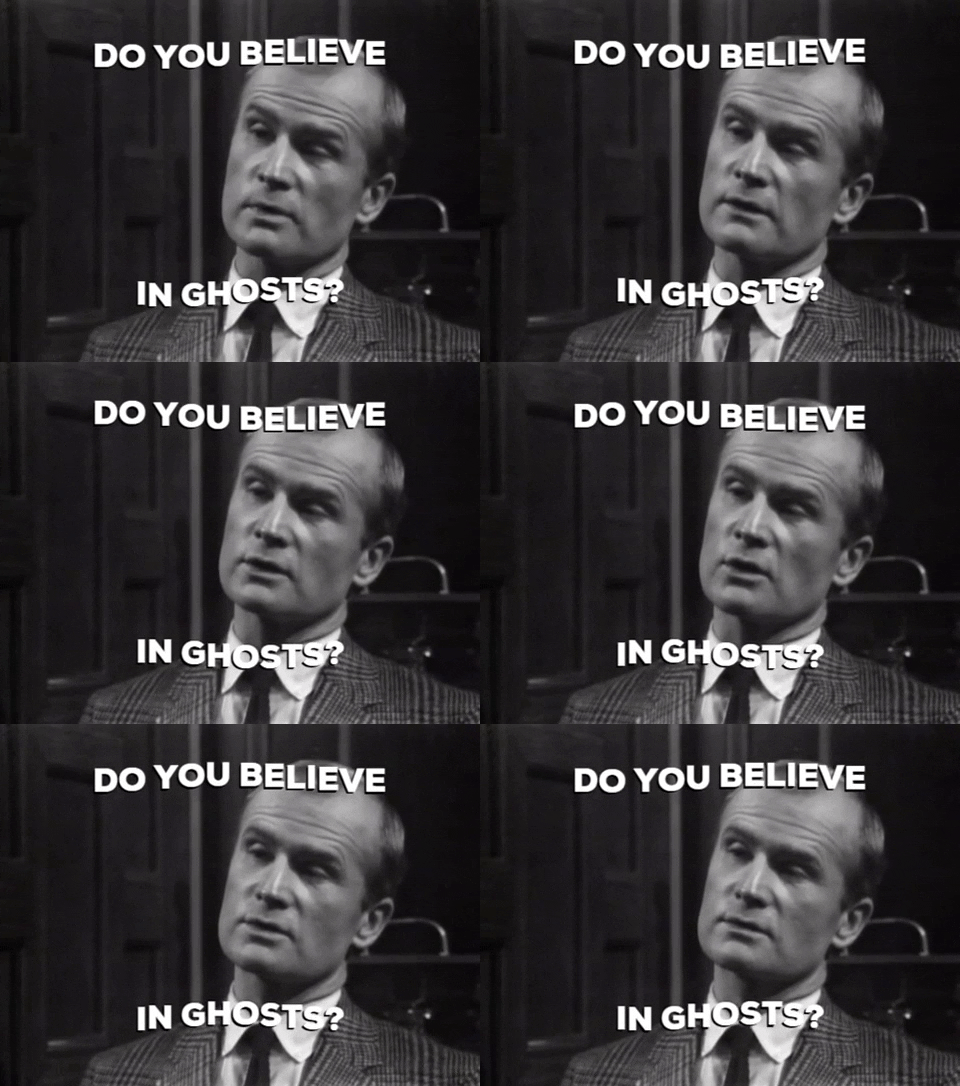

So the new explanation is that Vicky is insane and believes she is being constantly set upon by ghosts. The thing is…Burke and Liz both know Vicky has claimed to have been visited by ghosts. Unlike Liz, Burke has never seen any physical evidence to support this story, and hasn’t really been receptive to it at all, despite his fondness for Vicky.
Burke, perhaps knowing thing, pivots to something too painfully real to be argued:
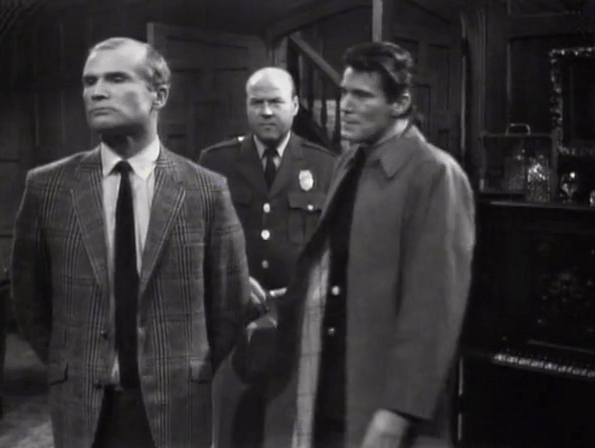
It’s pen time again.

It’s remarkable how Elizabeth is the last occupant of this house to hear about any of this. Burke doesn’t even give her leeway to demand what the hell he was doing giving baubles to her daughter while they ate French fries at a fancy restaurant.
This reads like a grand climax to the saga of the sterling silver filigreed fountain pen, with Burke lovingly recounting every instance in its long journey from hand to hand.
Roger repeats his story that he lost the pen before he ever went out to meet with Malloy. Well recall that in his nonsense story that he told Vicky, he did lose the pen at Lookout Point…after showing up to find Malloy already dead. Obviously, he knows how bad this sounds, so it’s back to the usual story.
Roger doesn’t deny that Vicky did find the pen at Lookout Point, but suggests “someone else” found it before hand and then lost it.
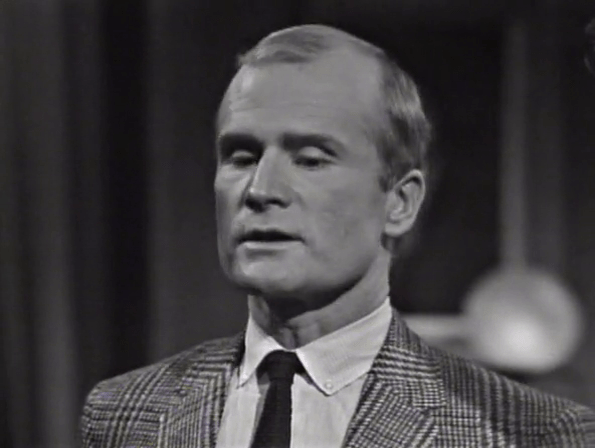
This is getting pitiable.
Roger spins a narrative that Malloy found the pen when he confronted Roger at Collinwood that night, stole the pen because he liked shiny things I guess, and then dropped it when he fell off the cliff at Lookout Point, which is how Vicky found it on the beach days later.

In a Mad Libs, sure. To the credit of everybody here but Roger himself, nobody entertains it for more than two seconds, with Burke repeating the real most obvious explanation: that Roger lost the pen when he threw Malloy into the sea.
Elizabeth somewhat reluctantly objects to this line of questioning, because Roger is family after all, and she does have a thing about protecting her family, however difficult they make it for her.
Difficult, for example, like telling Vicky that stupid story to explain how he lost the pen, which Burke subsequently reminds him of.
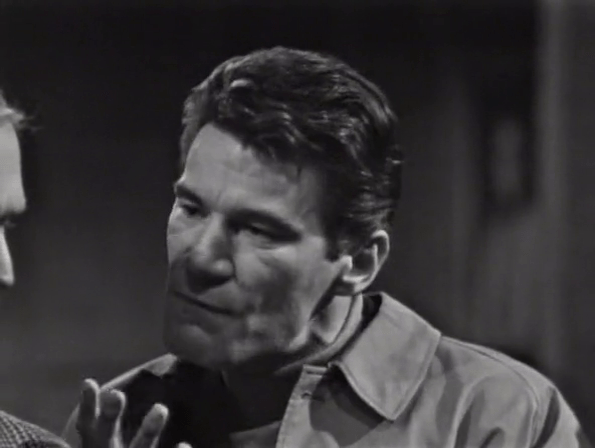

Roger claims that Vicky imagined this story because she’s nuts and stuff.
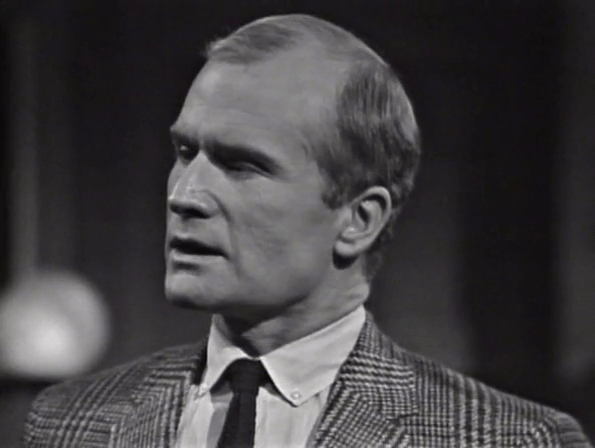
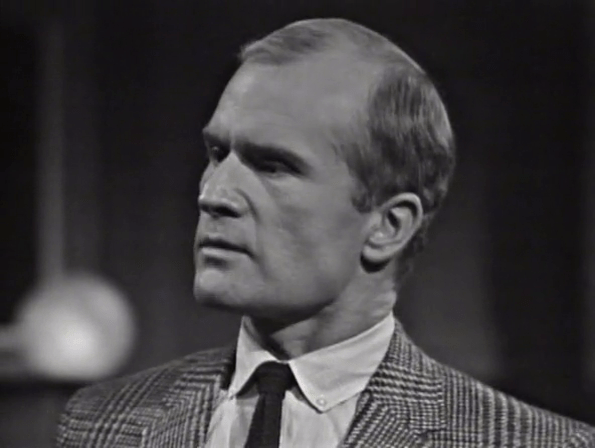
It would be that, yes.

I also think there should be something in one of those statutes about disposing of a body, but oh well.
Roger, with due smugness, plays his trump card:

Burke points out Roger feels pretty safe asking this question, because he’s already secreted the pen away somewhere and knows all this talk is just hearsay and, as Francis Swann will never stop reminding us, this can’t go anywhere without some kind of concrete evid…

HOLY SHIT
As silly as this is out of (and, hell, in) context, this moment also represents the high point of Swann’s writing for the show.
Let me finish.
It’s a deft and well-done reveal and, even better, it isn’t spelled out explicitly, relying on the audience’s intelligence to piece together what happened, while at the same time not digging so far back into the show’s history that the average audience member wouldn’t understand what was going on.
We know that the only reason the matter of the silver filigreed fountain pen was revived was because Victoria saw its twin with Blair in Bangor a few weeks ago. We also know that Burke went to Bangor last night to get his “crazy plan” into motion. Roger has no way of knowing about Blair’s pen, so he believes Burke somehow got ahold of the first pen which he buried in the woods.
It’s a deft and excellent twist, involving no retcons, no suspension of disbelief, and no pedantic recapitulation. For Francis Swann, it’s practically Dorothy L. Sayers.
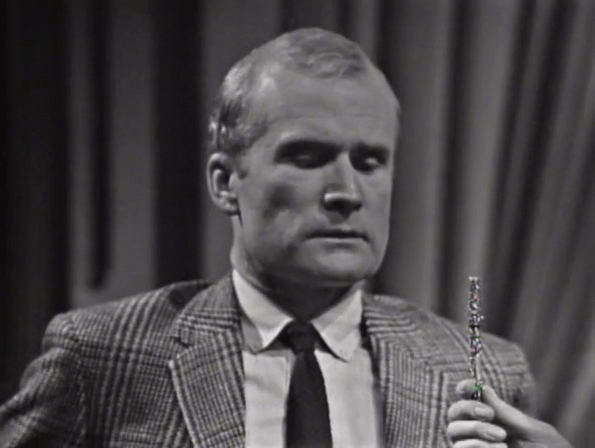
Roger doesn’t know what to say. He flounders pathetically, sputtering that this can’t possibly be the same pen. And he’s right of course. I suppose if he waited a second, he could remember that Vicky told him Blair had a pen of his own, but let’s just forget that detail for a second and luxuriate in the fact that someone on this show has done something intelligent.
Roger makes a big show of examining the pen closely before declaring that, on second thought, it probably isn’t the same pen because reasons. The issue stalemates here, with Burke promising he intends to question Vicky and Carolyn about the pen later, a notion which Patterson, seeming to remember where he is and what his job is supposed to be, declares they’ll do in the morning.
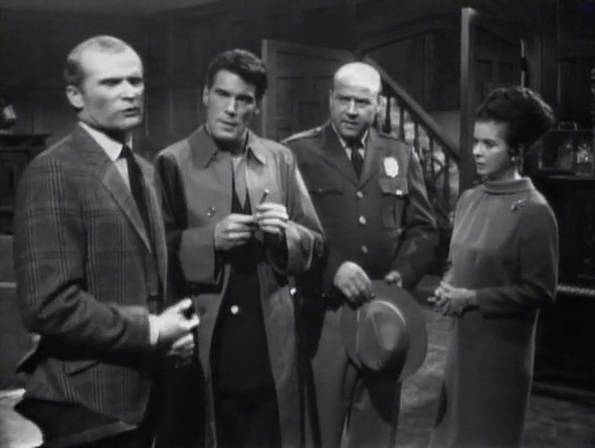
Actually, there are only six and four are in South America and if you ask more questions than that a mysterious order of robed figures will come to you in the night and you’ll never see sunlight again.
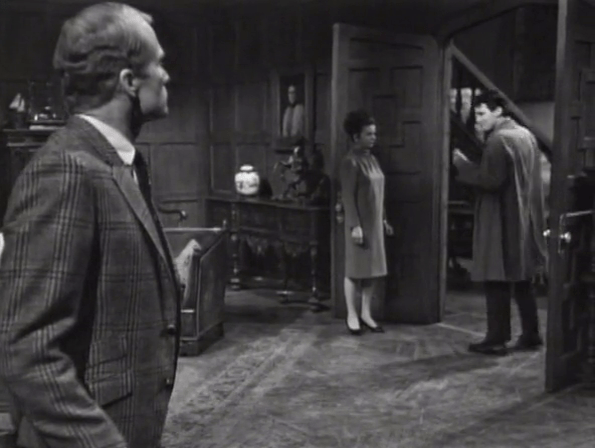
Their mission concluded, Burke and the sheriff get into the latter’s silly car.
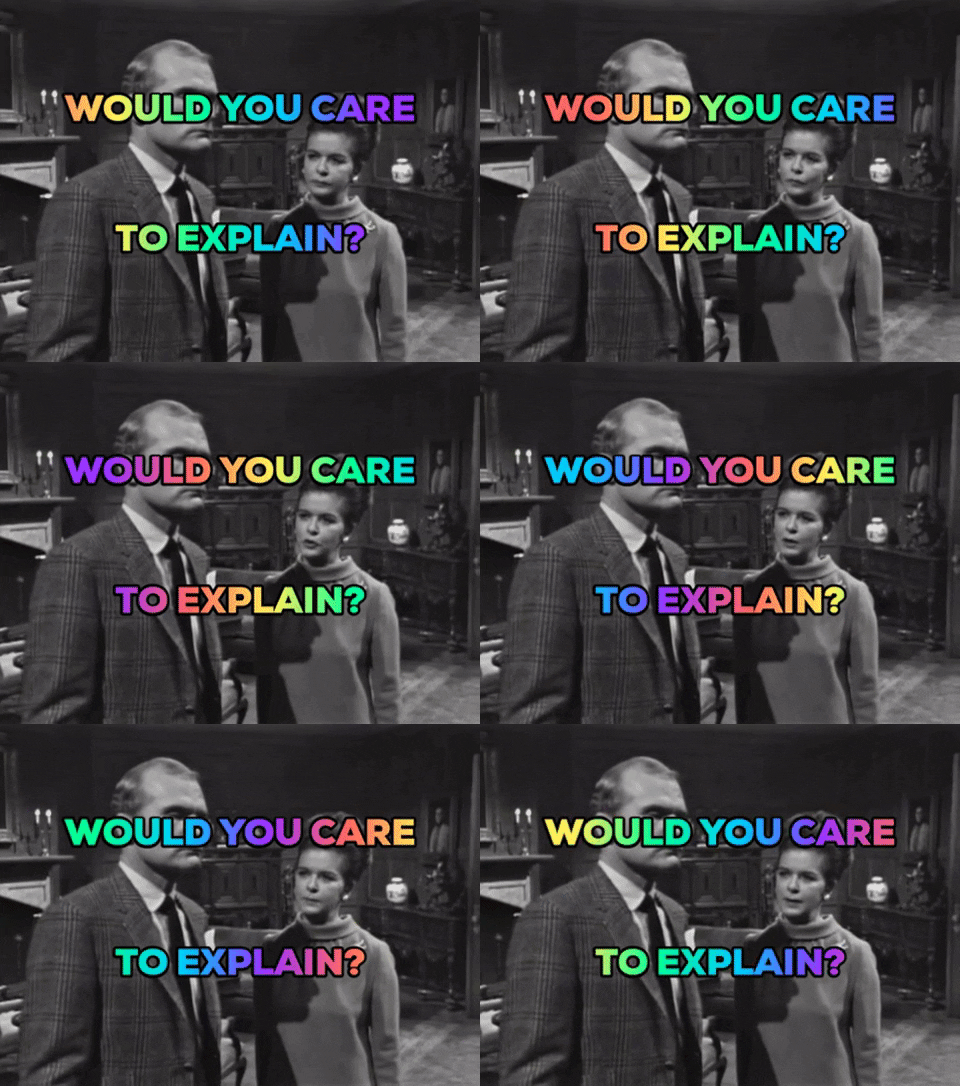
Sadly, we don’t get to see Elizabeth rip his still-beating heart of his chest for subjecting her to this nonsense, but just when you think the episode is about to end with nothing but the inconclusive promise of Vicky and Carolyn being forced to tell pen tales on Monday, Roger decides to return to the scene of the crime, you know, that thing criminals always do, allegedly.

Roger was so spooked by the pen being produced before his eyes that he simply must hasten to the woods to determine if it’s still there.
We get a whole production of Roger sifting through the soil with a comically outsized spade. It goes on to the point that it’s out of pace with the music, suggesting to me that Louis Edmonds actually lost the pen briefly in the dirt and had a moment of panic.

After the requisite amount of rummaging, however, Roger produces the pen, which was just where he left it the entire time, proving he had absolutely no reason to worry.
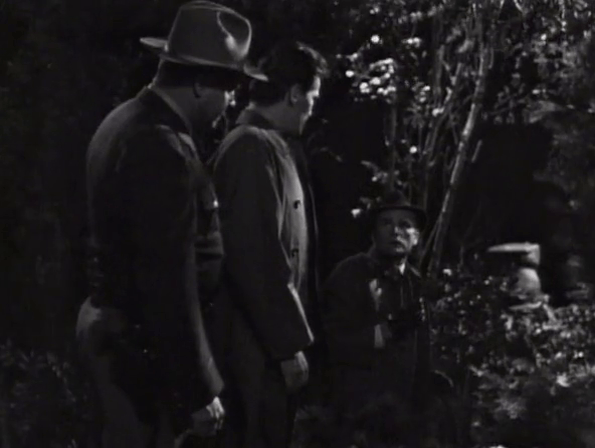
Until now. Roger freezes like he’s been caught touching himself or something.
And so concludes the saga of the sterling silver filigreed fountain pen, with a man kneeling in the dirt, about to be arrested for unclear crimes.

Gotta hand it to them. The plan was crazy enough to work after all!
This Day in History- Friday, November 18, 1966
Sandy Koufax shocks the baseball world by announcing his retirement at the height of his career, due to severe arthritis.
The Roman Catholic Church decides that it’s kind of silly to insist Catholics can’t eat meet on Fridays and quietly chucks that rule in the bin following approximately 1,100 years.
 Kooks of Collinwood
One thought on “The Telltale Pen”