
“Plot-thread” is an expression derivative of “storyline”, meaning the progression of a narrative through a plot, which is commonly understood as being a dramatic device with a beginning, middle and end used to tell a story.
“Plot-thread” is used mostly to denote when a storyline has been left “hanging”, hence the expression “hanging by a thread”. Wherein the latter expression may imply peril (“Our chances here are hanging by a thread”) , in reference to a narrative, a “hanging plot thread” means that a storyline has not been resolved, is, in fact, “dangling” like a loose thread in a piece of fabric.
For example, when Victoria Winters tells us:

We understand her to be referring to a nebulous group of “fears” which all originate in stories the show has tried to tell and, in many cases, dropped.
These “strands” range from the secret of Vicky’s parentage, a thread that has determinedly revealed no new information since the first week, to the supernatural nature of Collinwood, something that has begun to be revisited, but only so much that various characters have begun to admit supernatural things do occasionally occur at the great house.
Other hanging threads include Elizabeth Collins-Stoddard’s desperate and aborted attempts to get in touch with Ned Calder, Joe Haskell and Carolyn Stoddard’s fraught relationship, David’s threat that Victoria would be “sorry she ever came here” (they apparently had an uneventful offscreen school lesson last episode), the contents of the east wing, the contents of the locked room in the basement, the contents of the letter Sam Evans wrote to his daughter “in case something happens” to him, the nature of just what Sam knows about Burke Devlin’s manslaughter conviction…
Indeed, Dark Shadows is a nest of hanging threads. This is not necessarily unusual for a soap opera, but it is strange how adamantly the show is delaying the progression of even its core mysteries.
Now, though, as we approach the end of Dark Shadows’s eighth week on air, there will be attempts to move at least one story along, although this progression does less to resolve one mystery than give rise to a dozen new ones.
It’s the Soap Wheel principle, but handled badly.
What hasn’t been handled badly is the return to our screens of Sam Evans, now played by David Ford. He’s almost rounded a full week’s worth of episodes, being absent in only one since his first appearance in Episode 35. If you have been at all paying attention to this blog since then, you know that I have an unhealthy obsession.
And well I might. We open the episode with Sam sipping from a cup of coffee and regarding a portrait on an easel…
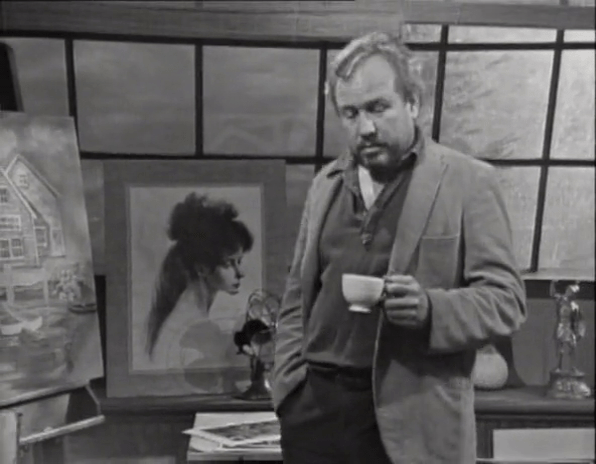
I refuse to believe that aside was written into the script. Rather, it is almost positive that Dave Ford decided to have his character comment on one of the many pieces of art lying around his house, all of which, we must assume, are his own work.
There’s no reason for that line, except that it helps us understand the character more. His drive to create, and the cynicism that has impaired his creative process.
A knock comes to the door.
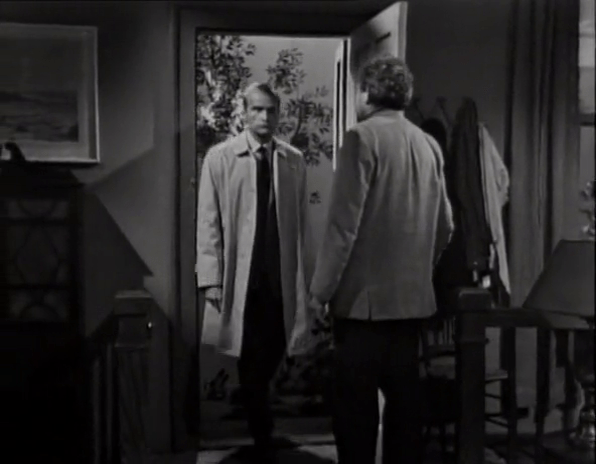
Roger’s visit was apparently planned. They spoke on the phone, Roger urging Sam for the hundredth time to call off Burke’s portrait commission.
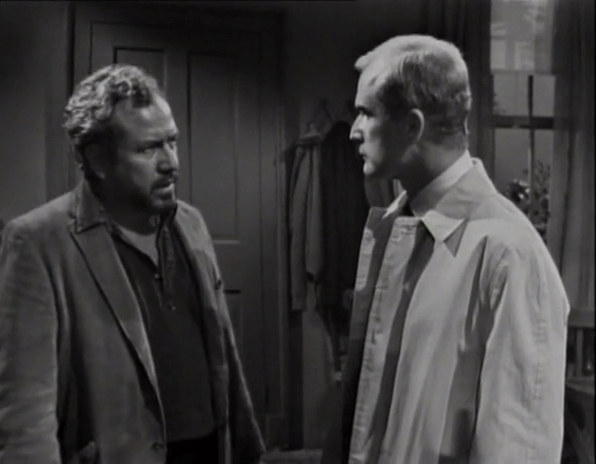
Nothing, Sam continues, but one.

If Roger is fazed that Sam’s sincerely considering putting together his will (no doubt in response to Roger’s many intimations that he will do “whatever it takes” to protect himself), he doesn’t show it.
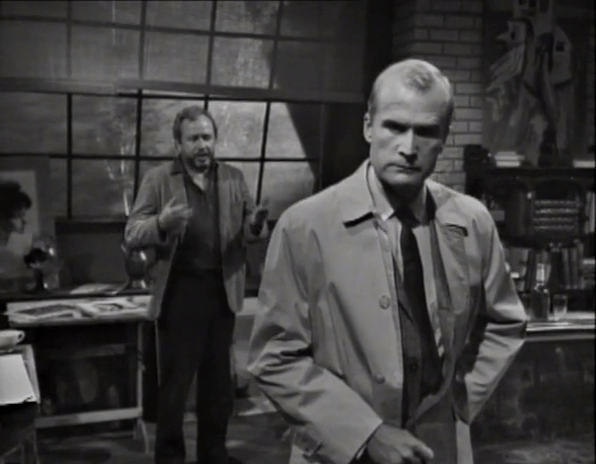
The bigger question, of course, is why Burke is going so hard for this stupid portrait anyway. We know it’s because he wants to hang it in the Collinwood drawing room once he has successfully conquered the place and everything else the Collinses own. This is stupid, but at least we know what he’s planning. Nobody else has expressed much curiosity about the painting. It’s all quite usual proceeding, I suppose, for this much trouble ($1,500) to be wrought from a portrait commission.
Roger’s concern has nothing to do with the portrait itself, obviously. He just doesn’t want Sam and Burke together for lengthy stretches of time, given the risk that Sam will say something to give away his involvement in the events of 10 years ago…whatever that may have been.
Sam says it’s too late.


As you may imagine, Roger’s reaction is very much that of someone caught cheating.
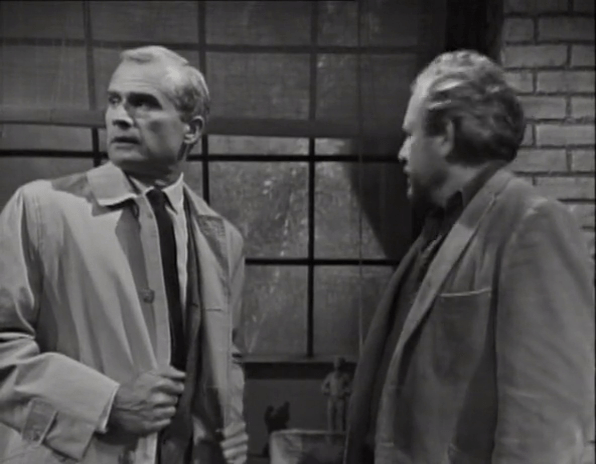
Oh perish forbid.
Sam suggests Roger slip out the back door.
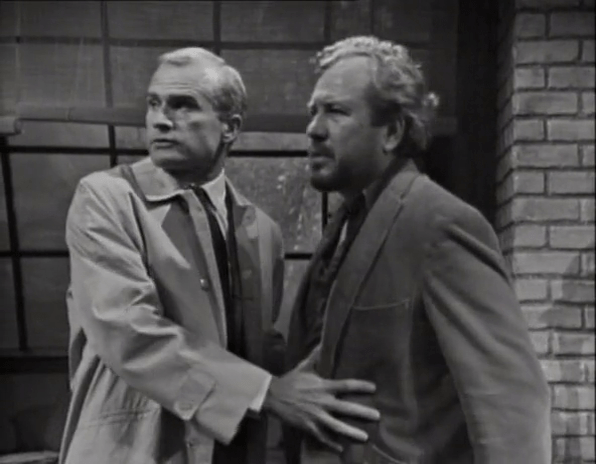
But Sam can’t pretend not to be home. Burke spoke with him on the phone last episode and knows he’s around the house.
So Roger’s solution, instead, is to hide in the house for the duration of Burke’s visit, a foolproof plan that offers not a single chance for Burke to suspect there’s anything weird going on between Sam and Roger, not at all.
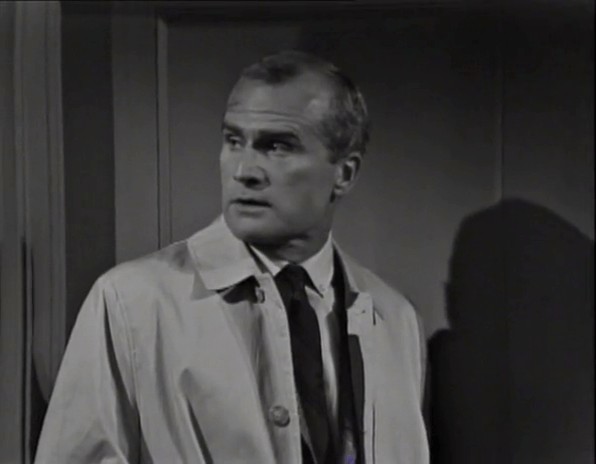
If we’ve learned anything on this adventure, though, you don’t just “get rid” of the Devlin.

You may recall Burke telling Carolyn that he had two engagements this afternoon: his portrait sitting and a business meeting in Bangor. What this tells me is that we are now, suddenly, in the “afternoon” on this in-universe day, having spent only an episode each on predawn and morning! Not that we’ll be jumping to night in the next one, but this shift indicates less of a willingness to spend over a dozen episodes on single days to the point where this show has aired nearly two months’ worth of episodes and Victoria Winters hasn’t been in Collinsport a week.
Mind you, it will eventually reach the point when you’ll wish they started slowing down, but for now appreciate this happy medium. Dark Shadows rarely ever attains the median on anything, so it’s worth noting.
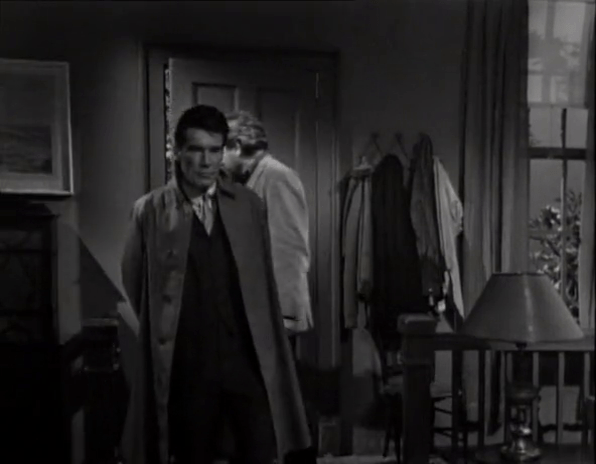
Wars have been fought for the amount of product he puts in his hair.
Sam attempts a series of feeble excuses to get rid of Burke: he has a headache, his hand is shaking. Meanwhile, Roger is in the closet.

Sam suggests they reschedule the sitting for “next week” which, slightly increased pacing aside, could very likely be Christmas.
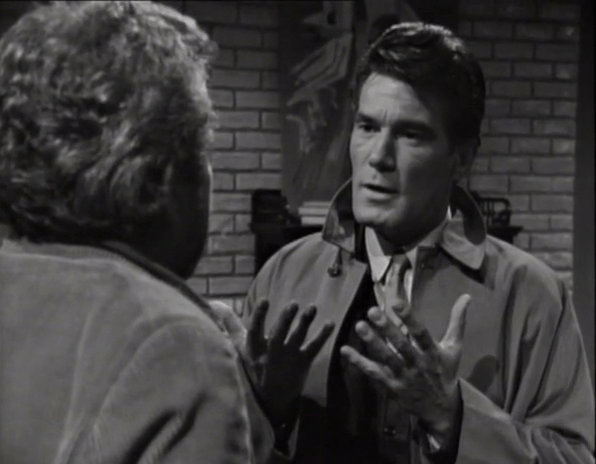
Then I guess Maggie will have to take an extra shift to afford physical therapy. Go fuck yourself.
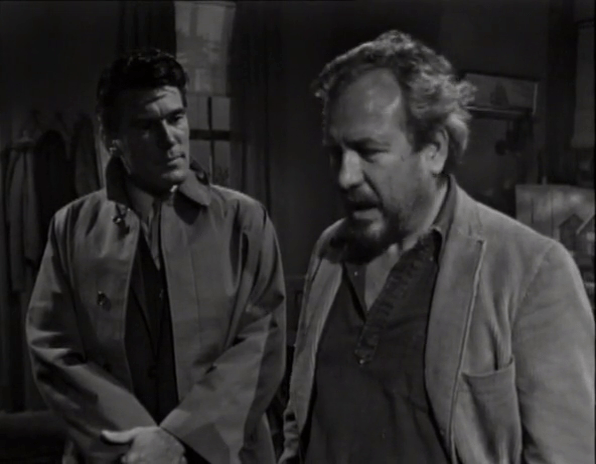
This returns to the hovering halo of uncertainty around Burke’s plans in Collinsport. The Venezuela Job is a thing of ancient history by now, the few people who had been told of it now confirmed of its falsity. At around the same time it was proved false, Burke was made to stay in town anyway while the intrepid Consteriff Carter investigated the Theft of the Purloined Suppository. But that case has since been resolved. Burke has no further prepared excuse for his stay in Collinsport and he has not yet given one, though his “business meeting” in Bangor indicates it won’t be much longer until the true scope of his plans begin to become known.
You’d think.
More to the point, Burke isn’t sure if Sam isn’t planning to hightail it to Kalamazoo before the week is out, citing his repeated and increasingly hilarious attempts to drop this portrait business altogether.
Burke reminds Sam that he guessed already it’s Roger who is so determined to keep Sam from painting him.
Sam finds himself unable to resist anymore of Burke’s delicately enunciated entreaties and the portrait sitting commences.
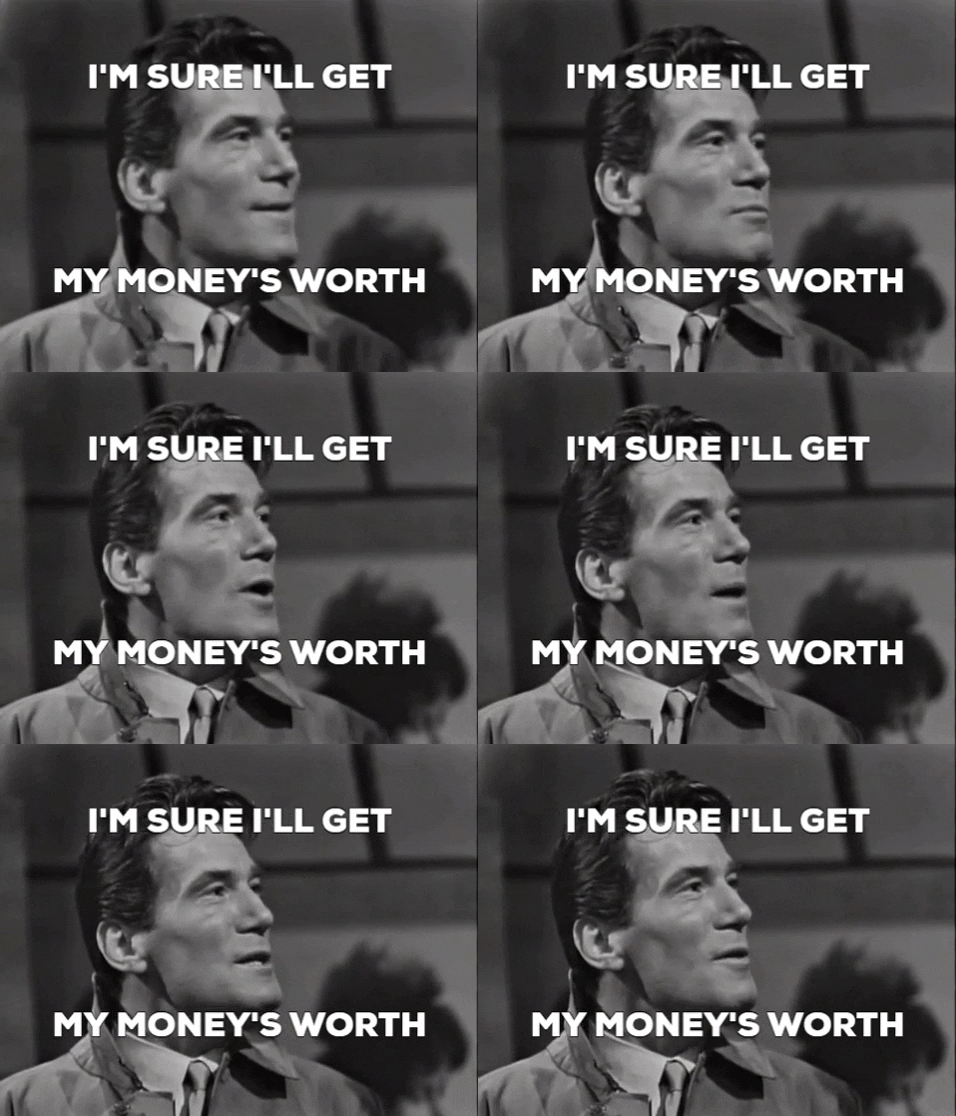
After all this stalling, we’d all better.
Remember Bill Malloy?
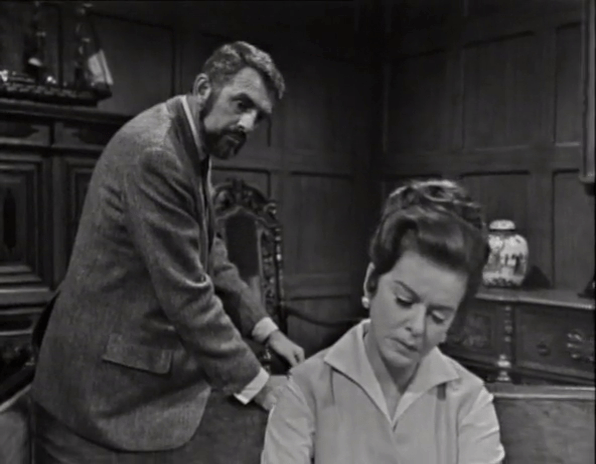
The manager of the Collins fishing (in the Consteriff’s words “flishing”) fleet and cannery last appeared in Episode 32, where I dedicated a very large amount of time to describing how and why he fell off the map of the show during the suppository era after being a fairly significant supporting presence in the first month, including being the only member of Team Collins actively seeking ways to undermine Burke and discover what he’s plotting, rather than just talk and dither about what Burke is or is not plotting.
So I won’t repeat the spiel. The point is Malloy is back and, indeed, for the first time it seems Dark Shadows knows what to do with him.
There is no obvious evidence of this at first. Liz is signing contracts for new machinery at the plant, similar to the papers Malloy brought her way back in Episode 9, which turned out to be just a thinly-veiled ruse so that he and Liz could talk about Burke and vow to battle him together.
Not much battling has happened since. Malloy did figure out Burke had hired a detective. Mind you, he did this offscreen and, since this fact was confirmed absolutely nobody has done anything about it, (add to our list of dropped threads) but dammit he did something.
There is a nice detail here with Liz, one that may have hit home for a segment of the viewing audience in 1966 but has implications even now at the dawn of the Moaning ‘20s.

Malloy assures her that nobody will be laid off by the implementation of new machinery and only then does Liz put her name to paper.
Liz doesn’t want her people to lose their jobs. The Collins enterprises are treated as the employers of the majority of the entire town. While this has the seedy effect of giving the family undue power in the elections and behaviors of local officials, there is the opposite end that the Collinses don’t run the town like feudal lords over their serfs. At least not as long as Elizabeth is in charge.
Among Dark Shadows’s many weird cultural takes, one thing that stands as surprisingly progressive is the prioritization of the worker over the automaton. Fears of cheap automation outsourcing human labor have reached fever pitch in a world where corporations seek to produce cheap product by cheap means at the expense of consumers, climate and their own workers.
But dammit the Collinses still can their tuna with human hands.
It’s a much-needed good look for Liz, given the increased volatile nature of her lies and manipulations. She might ask her most loyal employee to take the responsibility for a man almost dying, but she does look out for the employees she never sees.
This bit of business done, Malloy sees fit to tell Elizabeth about Burke’s snooping approximately 18 episodes after we first learned he’d discovered it. There is an added aspect to it, though…
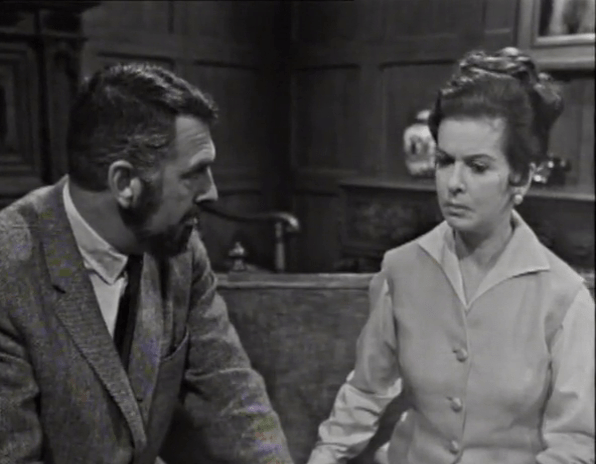
This, is of course, hearkening to that time Barnard fucking Hughes was on this show. Burke met with his man Bronson yesterday afternoon to discuss the research Bronson’s firm was doing into the Collins holdings so he can prepare for his next step in his journey to become the Count of Monte Shameless Ripoff: buying all the Collins debts.
Liz, who I guess is not familiar with the book (or, indeed, common sense) wonders what reason Burke would have to do this research.
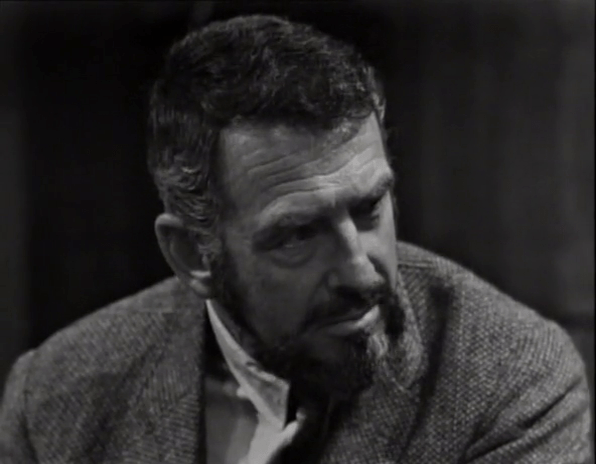
Is this a daytime soap opera or the goddamn Reading Rainbow?
In this 19th century revenge allegory, Burke is likened to Captain Ahab, with the Collins properties being the great white whale Ahab zealously pursues to the point of his own destruction. Where the infamous sperm scene fits into the picture, who can say.
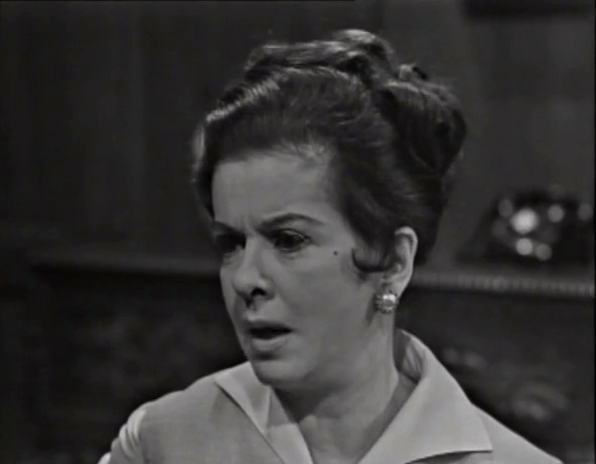
Stirring discussion in book club, today. Can we bring in Matthew to discuss his thoughts on Melville’s distaste for allegory?
Malloy admits that, unlike in Strake’s case, he can’t prove Burke has been doing this prying and what follows is a very, agonizing pause in which we can only assume Joan Bennett is desperately trying to remember her line, or else waiting for an imaginary line she has convinced herself Frank Schofield has to say.
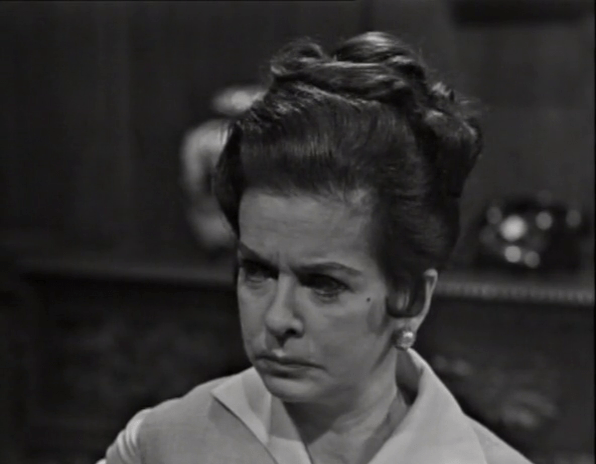
Malloy insists they must act now before it’s too late, a very similar stance to that he took in his first scenes with Liz 30 episodes ago, so you can understand his impatience.
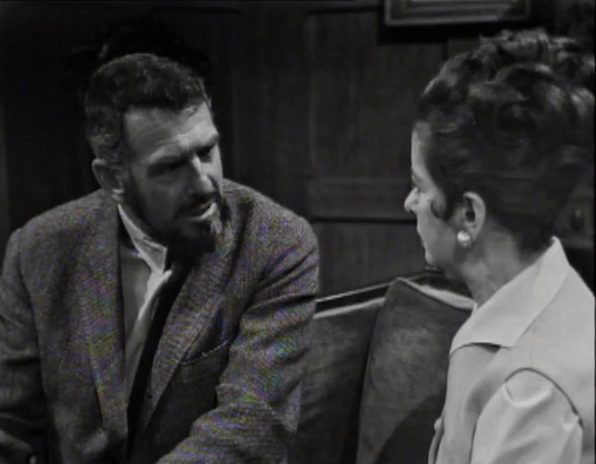
Aw, shucks.
Malloy wants carte blanche to deal with Burke and Liz isn’t going to give it because I guess inaction is wisdom all of a sudden. It was cute with Roger, but Malloy has evidence that somebody is plotting corporate sabotage against the business intrinsically linked to the family dynasty she has done horrible things to protect.
The phone rings. Malloy gets it this time and guess what?

Gee willickers, it’s Ned Calder!
If you’re anything like me, you’ve been wondering why Liz has made a point about trying to get in touch with this Ned Calder character all week. If you’re anything like me, you’ve drawn unfortunate conclusions about the kinds of stories that might be pulled from this.
I will submit, without commentary, this screencap to give you an idea of just what may be waiting in the wings.

There’s more!
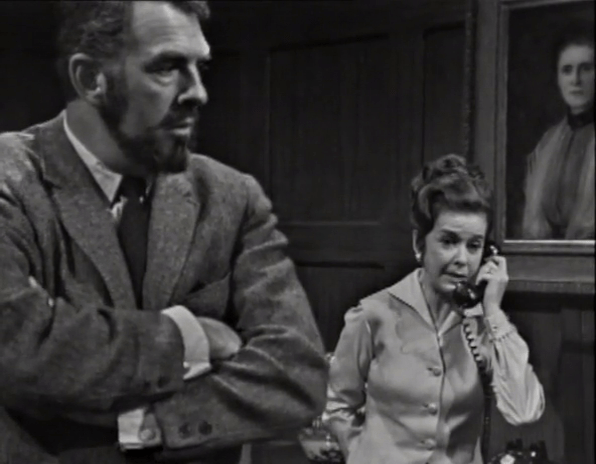
It turns out, further, that Ned has another job, but this means nothing to Liz, who asks that he drop whatever job that is and return to all of the fishes in the deep blue sea. Joy, I say, to you and me.
Malloy provides us more context to understand what’s going on here.
Sidenote: when you’re dealing with a character that hasn’t been introduced or discussed at all in any capacity, it is a bad look to have everything revealed about him second hand, especially if you want people to care.

Malloy, whatever his uncertain expression earlier testified, claims to have no ill-feeling toward Calder, and suggests he’d be a good person to have in their corner against Burke. In fact, Calder had half of Malloy’s job (business manager, not the charge of fishing fleet) for 15 years before abruptly quitting and leaving town, where Liz has been glad to see the back of him until now, when she all-but begged for his return, which is a lot of story to come out in a conversation that totals about 90 seconds.
Earlier in this post, I alluded to the Soap Wheel. That is, the idea that serialized storytelling is (or should be) cyclical, with stories rising and falling in a constant ebb and flow so there’s literally never a dull moment.
The Soap Wheel is a delicate and tricky writing device. Most soaps nowadays are helpless at it, with myriad stories on intersecting paths. Primetime drama sometimes pulls it off well and comic books have to be good at it, given their serial output puts similar demand on writers and artists as in the writers and producers of daytime drama.
To properly maintain the structure in a Soap Wheel, stories must rise and fall with fluidity, being introduced “quietly” in the shadow of bigger stories so that, when those bigger stories are wrapping up, they can take the fore.
Even in the case of the Suppository Saga, there were elements seeded ahead of time, most notably with Liz seeing the oil-soaked David return to Collinwood a whole week before the actual car crash happened. Not the most subtle instance of a plot-thread in waiting, but sufficient.
Ned Calder is an aberration to the very existence of the Soap Wheel. He appears (or is mentioned, rather) ex nihilo as one of many attempts to fill the void left behind by the suppository saga as it rapidly becomes clear that there ARE NO MORE STORIES. The Burke and Victoria stories haven’t gained enough traction to conclude yet, mostly because of Art Wallace’s lack of playing with them Soap Wheel style during the suppository story, so they can’t be sufficiently advanced.
All that’s left is to play with things. Mix and match characters, bring the ghosts back, throw out shiny plot devices (Sam’s letter, Vicky and Burke’s date, David’s threats), examine them and dump the ones you aren’t interested in.
Ned Calder is the most obvious because, unlike any of the other things tooled around with during this period of the show, he was never even hinted at before and yet now Liz regards him as a potential savior in the face of the looming threat that is Burke Devlin. It’s clumsy writing and it does no favors for the character or for the show.
Also, why isn’t Malloy offended? He’s been busting ass trying to take Burke down since day one and here Liz is calling his predecessor as if he’s her only hope. Instead, he seems to think it’s a pretty swell idea.
You know what would’ve been more interesting? Giving Malloy all the things Malloy and Liz imagine Ned Calder could do against Burke, and have him do them this entire time.

Yes, we absolutely must stop that dastardly Devlin from his devious plan of…
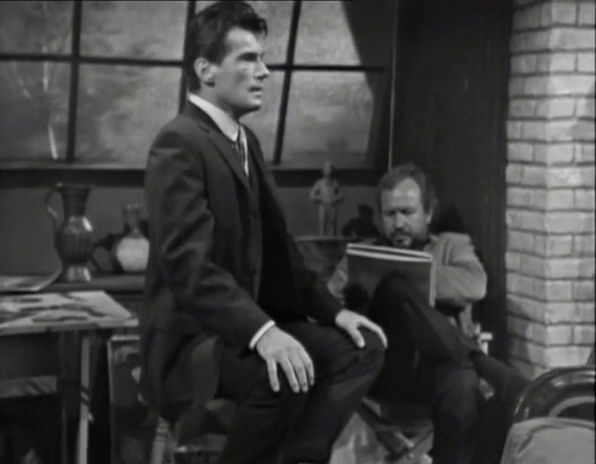
Presumably thinking of the paintings he’s plotting to replace, Burke asks if Sam’s ever been to Collinwood, which he has, apparently, once.
Burke describes the Collinses as “them against the world; they don’t care who gets hurt”. Sam allows only that he always thought Elizabeth was pretty swell… And then Burke asks about Roger.
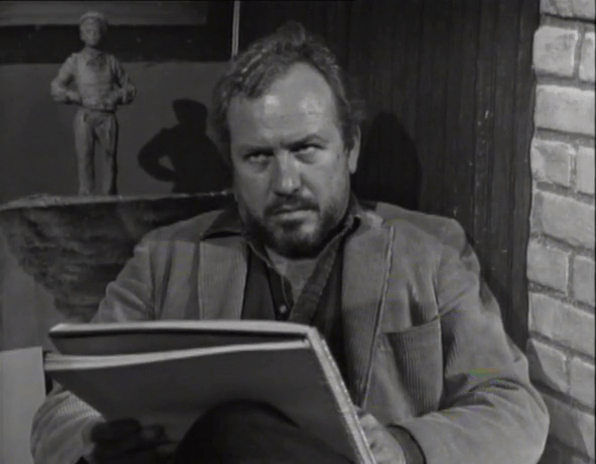
There’s a certain reality TV flavor to all of this. Roger is hiding in the closet. Sam knows this, Burke doesn’t, Sam knows he can’t talk too much about Roger with incurring Roger’s wrath, and neither he nor Roger can go anyplace without blowing the whole façade.
Sam claims he never knew Roger very well, but in such a way that anybody who heard him would immediately know he was lying. Burke declares they take a break…

I gathered that was his resting state.
Sam hurries to pour a drink.
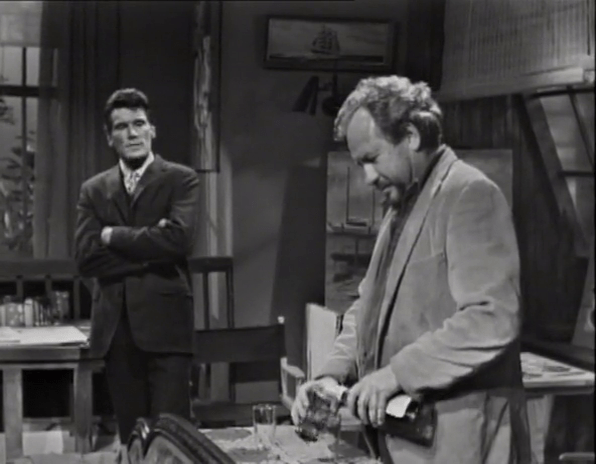


Burke, for whatever reason, doesn’t press this matter, despite having finally caught Sam in a lie. He takes his leave, promising to be back tomorrow.

Presumptuous of them, to assume this show had a year’s life in it.
Burke goes to wash his hands before he goes and this really is some reality TV level shit, isn’t it?
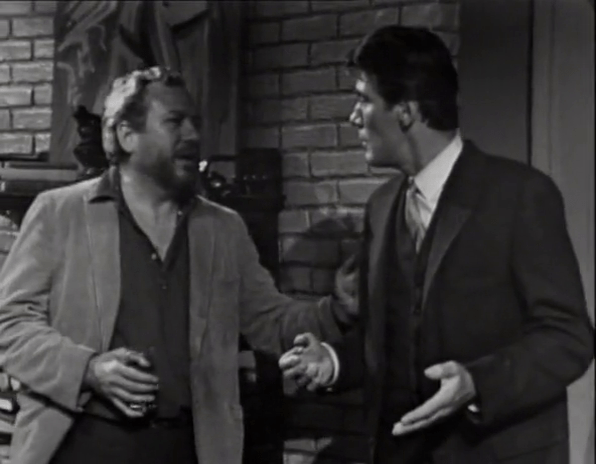
Ew, girl things!
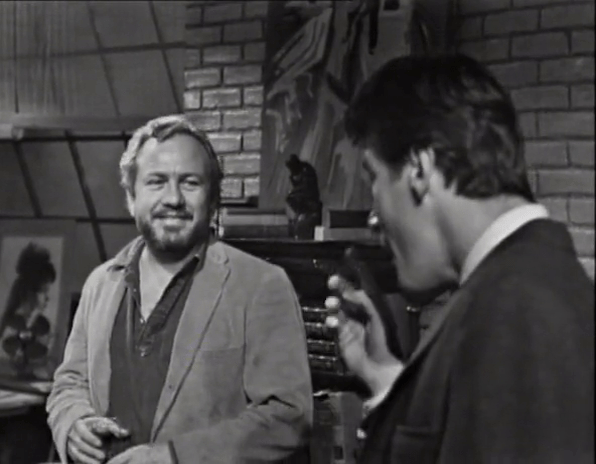
Yes, actually, he does.
The phone rings. It’s Malloy, looking for Burke after presumably being directed by the redoubtable Mr. Wells.
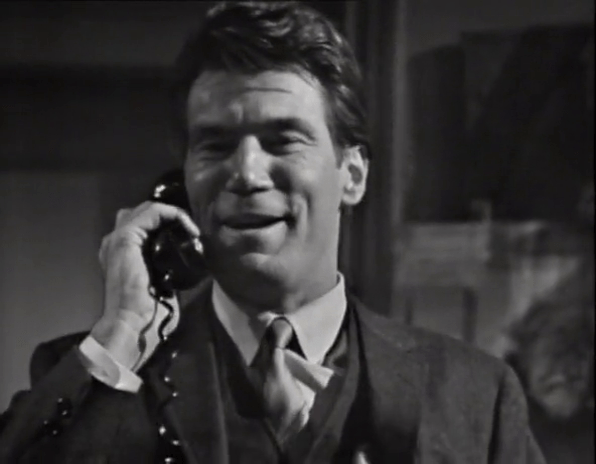
Burke agrees to meet with him in the restaurant. He takes his leave, leaving Sam to face Roger’s wrath.
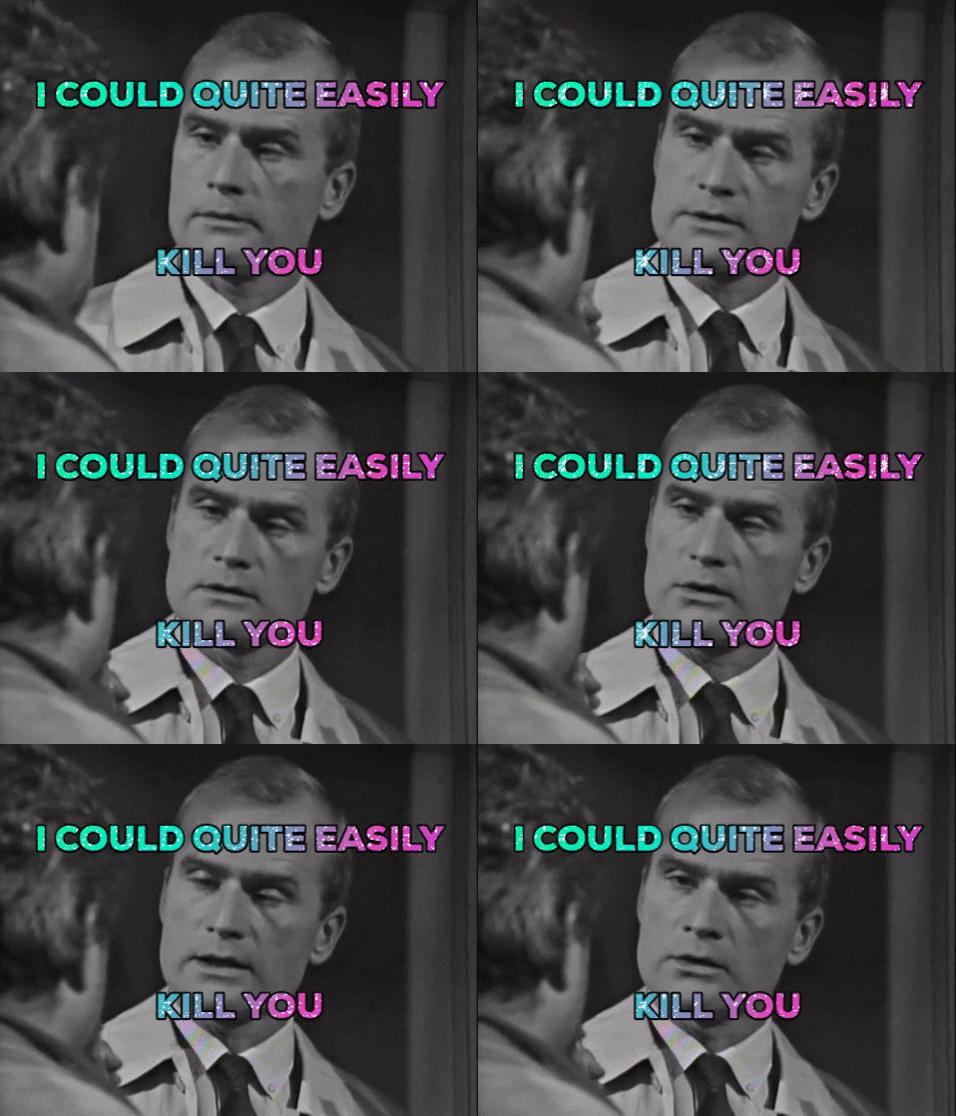
You know, he keeps saying that, and every time he says it, it becomes harder to believe. Like, how would Roger even do it? He’s not the guy to look a man in the eyes as he kills him. He lacks the physical strength to beat a man to death. He’s terrified of confiding in others, so he’d never hire a hitman. So, my conclusion is poison, likely administered via a Lucrecia Borgia-esque…
Where did Carolyn leave that ring again?
Roger is very displeased at Sam’s very poor “Nothing strange is going on performance”, which I guess is fair, but nothing we’ve seen of Roger has confirmed he could’ve done a better job.
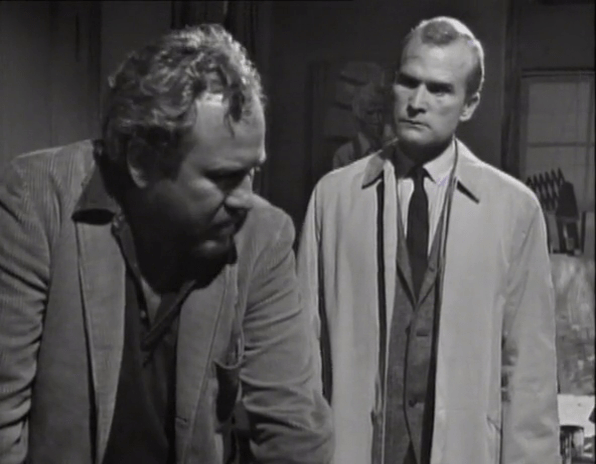
There are several philosophical holes in Sam’s argument, but the most obvious is that lack of answers only raises more questions and there is no way in hell Burke is less curious now than he was before he showed up for the sitting.
Still, what’s Sam supposed to do? He’s in an unenviable position.
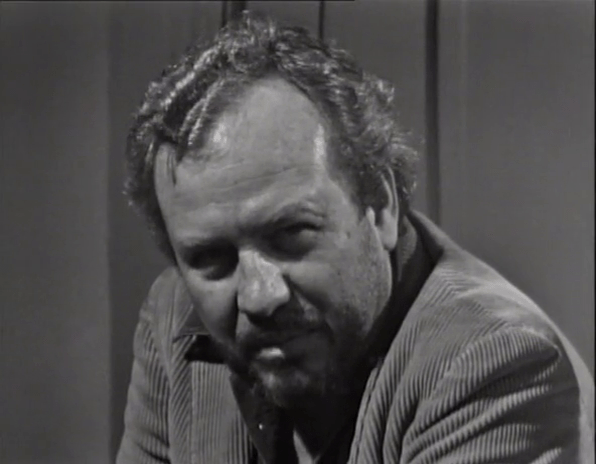
Ask a silly question…
Sam admits he was considering this himself, which possibly refers to his weird panic during his last few episodes as Cursed!Sam. It seems he dispensed with the notion around the same time he wrote that letter for Maggie.
So there’s another thing Cursed!Sam would never have done: stood up for himself. Even when Roger offers to foot the bill for his escape, Sam brusquely refuses.
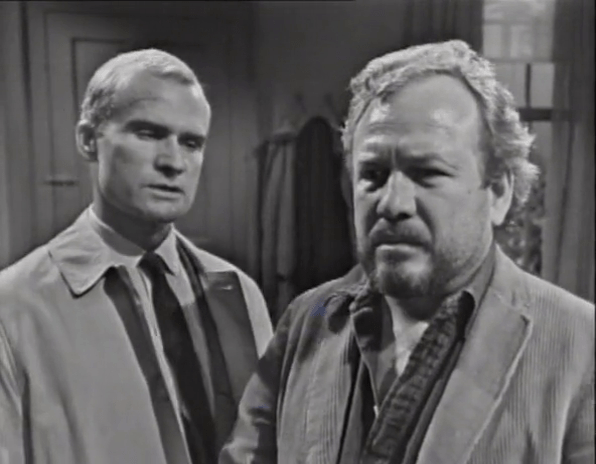
We don’t yet know just how much money changed hands between them after the manslaughter thing. It’s been implied this has to do with Roger buying a significant number of Sam’s paintings. The most evasive mystery of all is just what it is Sam knows, and in what way it is so devastatingly damaging to Roger’s safety in the whole case.
It will, naturally, be an inexplicably long time before we find out. Just be lucky it seems like things are happening.
Roger offers Sam $5,000 which…I have to catch my breath a moment…is $39,954.52 in 2019 money and, not that you asked, but I don’t make that much in a year.
Sam continues to be a Model for Life and maintains that he knows his worth.
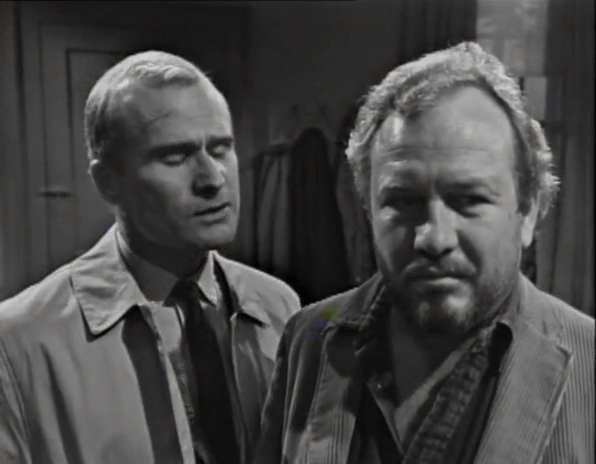
Recalling that this business would’ve been conducted in 1956, the $15,000 payout comes out to $143,077…and 20 cents. A decade on, however. Sam and Maggie still live in a two-room hovel whose only distinctive feature is a bay window, with Maggie still working an 18-hour shift at a greasy spoon, so we can only suppose the redoubtable Sam Evans isn’t very good with money.

To see the folks I dig/I even kissed a sunset pig…
But not even this inexplicably homosexual entreaty (“You can go to Ohio!” is, for example, something only a Straight would say) is enough to ground Sam. Damn it all, he declares, he will stay in town and he will paint Burke’s portrait, and he will not wet himself…er, give anything away. That is.
This is remarkable growth for Sam. Frightened he may still be, but he won’t let that fear, or even the indecision he took such pride in in his first conversation with Roger, to conquer him. He won’t give anything away to Burke; so he said and so it shall be.
And it…it will be.
Burke has gone to meet with Malloy as requested. Burke is his usual self.
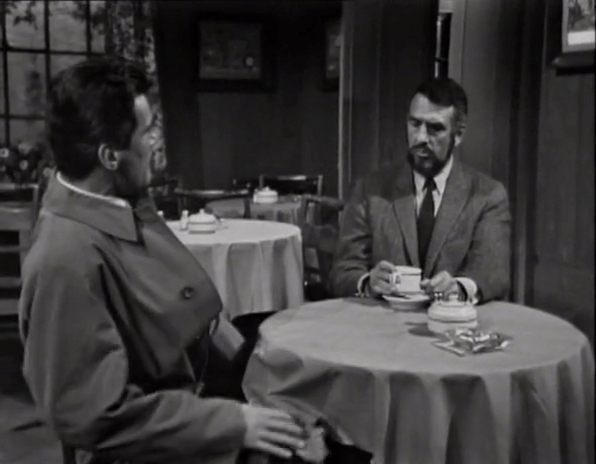
He was in an ongoing Broadway production at the time, I guess we can’t be too hard on him. Connected to this, isn’t it wild that there was a time that you could tune into a daytime soap opera and watch what was basically a New York-style stage production, increasingly stocked with New York theater actors? Now, you tune into General Hospital, you’re lucky to catch Colonel Sanders.
Not that venerable theater actor Mitch Ryan is not currently on my screen doing something interesting.
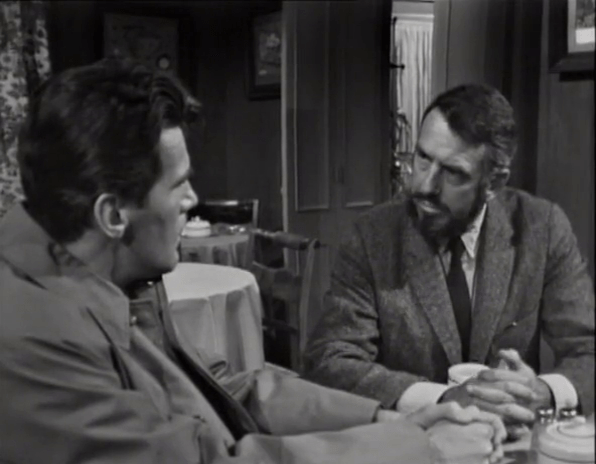
Evil, evil portrait for evil, evil plan.
Malloy has some devastating news, though.

To California?
Malloy becomes the first person in 39 episodes to look Burke in the face and tell him he knows what bullshit he’s on.
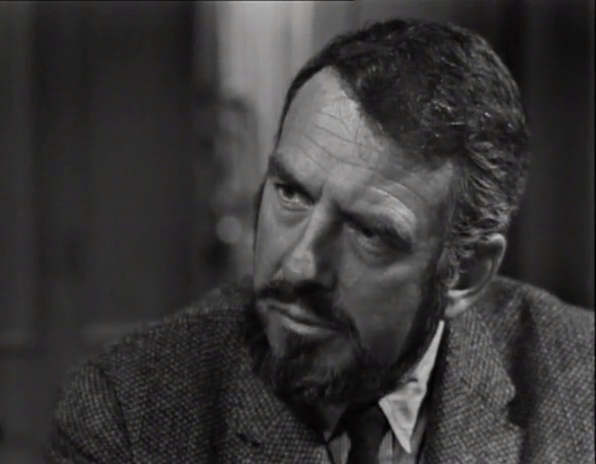
Mind you, this comes after their last scene together almost 20 episodes ago in which Malloy, again, had the hottest temperature on him of anybody in the cast, and seemed like the most willing to do something about it.
Malloy gets Burke to admit he has always felt the Collinses “railroaded” (that’s what Roger calls it at least) him into prison, though Burke refuses to admit whether he’s back for revenge, which I guess is fairly intelligent because to the conscious observer, he has done not one single thing connected to getting revenge since he’s come to town and, often, has worked against getting revenge. Best to keep the haters guessing.
And now, ladies and gents, seven episodes into this nebulous post-suppository era of the show, a new thread comes to dangle. And, by God, it seems as though the show will commit to it.

Oh my God, something is happening on Dark Shadows! Sound the alarms, call the fire brigade, contact my mother and show her what I’ve done with my Media Studies minor!
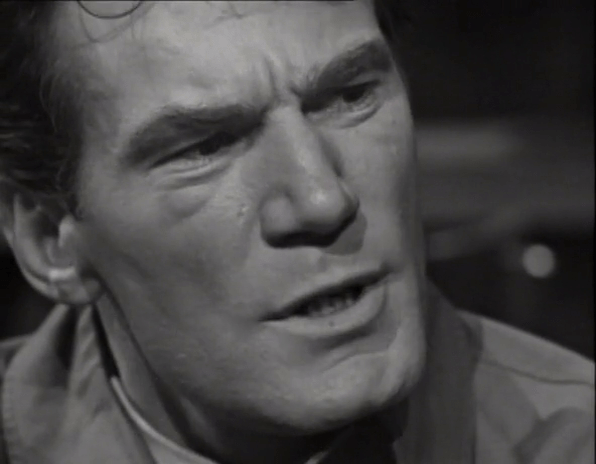
Malloy proposes a solution that will “help everyone”…

What little of it Roger still has, yes. And, yes, while Malloy’s motives are largely noble (defending the dignity of Elizabeth Stoddard), he does have a personal stake in this because, if Burke does buy the Collins businesses, he becomes Malloy’s boss, and he seems like the kind if employer who makes his people wear diapers on the job so they don’t have to use bathroom breaks.
Malloy continues: if he does help Burke out, Burke must promise to stay away from Liz, Carolyn (but they’ve been getting on so well!) and David (but they’ve been getting on so well!). Burke notes the omission in that statement… Roger’s safety is not at all assured.
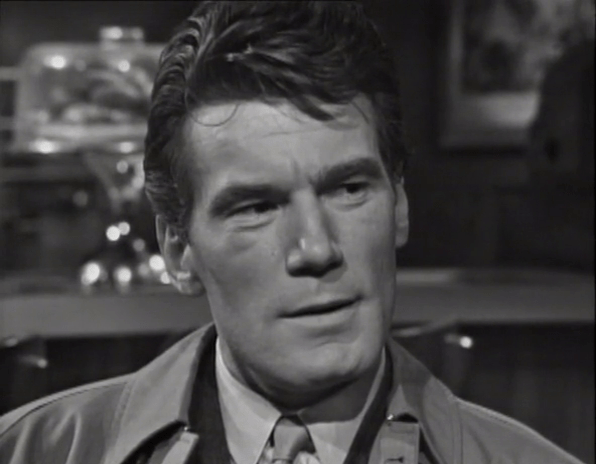
Sure. Can’t have too much happen at once.
Elsewhere, at the love nest.
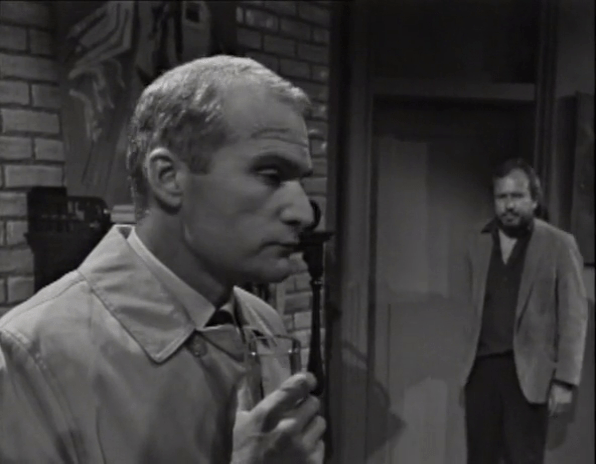
Apparently, not keen on not getting the last word in, Roger gives Sam a warning of his own.
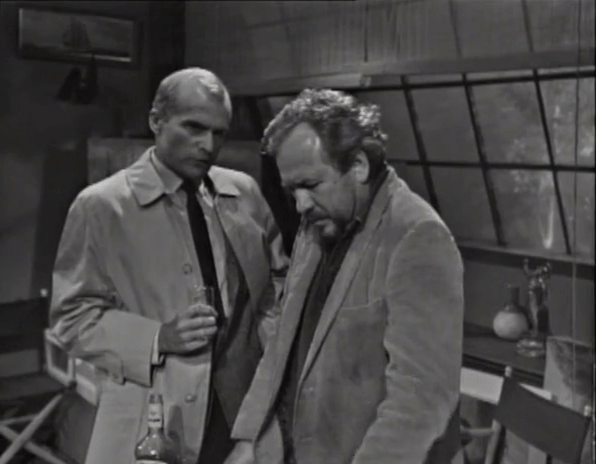
There’s this thing called “irony”, and I bet Rog will be just tickled when somebody finally explains it to him.
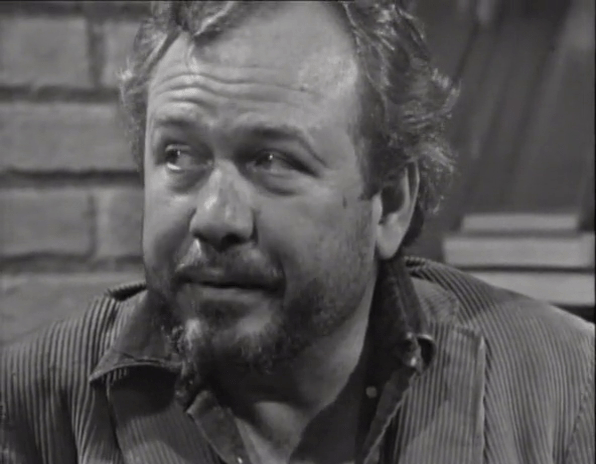
Sam describes the contents of the letter as a complete confession, the entire rundown on “everything that happened 10 years ago”, so it really seems like something is happening here.
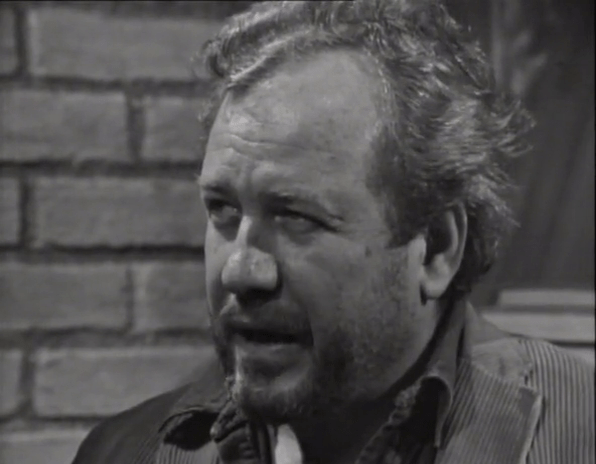
Roger doesn’t believe him, and Dave Ford gives us a delightful bit of delivery…
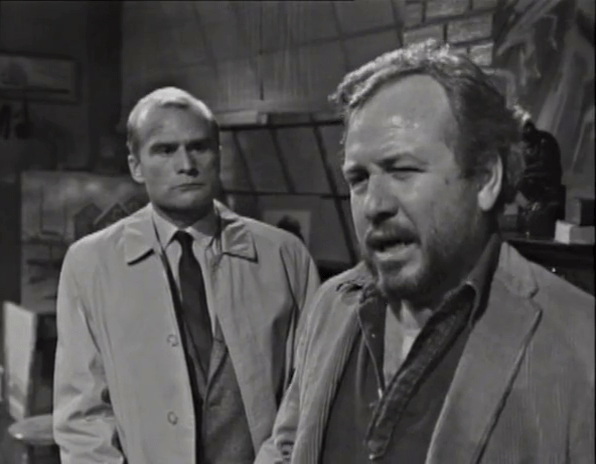
He never did, when you think about it. If only he’d seen that sooner. It can’t be understated how there’s only been a “New Sam” for, like, a week, and the show has moved light years ahead in terms of its main story. I mean, compare this to where we were two weeks ago, when the show’s entire sphere of conflict orbited around a tube-shaped piece of metal.

A cliffhanger! And it isn’t even Friday! And wait till you see what that episode has in store…
This Day in History- Thursday, August 18, 1966
Nearly one million members of China’s revolutionary Red Guards movement rally in Tiananmen Square to see Chairman Mao, who gave the stirring proclamation that “Without rebellion nothing bad can be fixed!” Which I’m surprised hasn’t appeared in more inspirational quote day planners.
The Battle of Long Tan sees the D Company of Australia’s 6th Battalion defeat a Viet Cong force four times larger than they. If you’ve been keeping track, this is the first non-Vietnam victory in the war since Dark Shadows began airing and, unless you’re Australian, you probably haven’t heard about this one.
Behind the Scenes Shenanigans
Episode 39 sees the return of John Sedwick as director. He will direct the next week’s worth of episodes. If you pay close attention, you can see he eventually becomes quite good. Not as good as Lela Swift, but…okay. Not as bad as that first showing, at least.
 Kooks of Collinwood